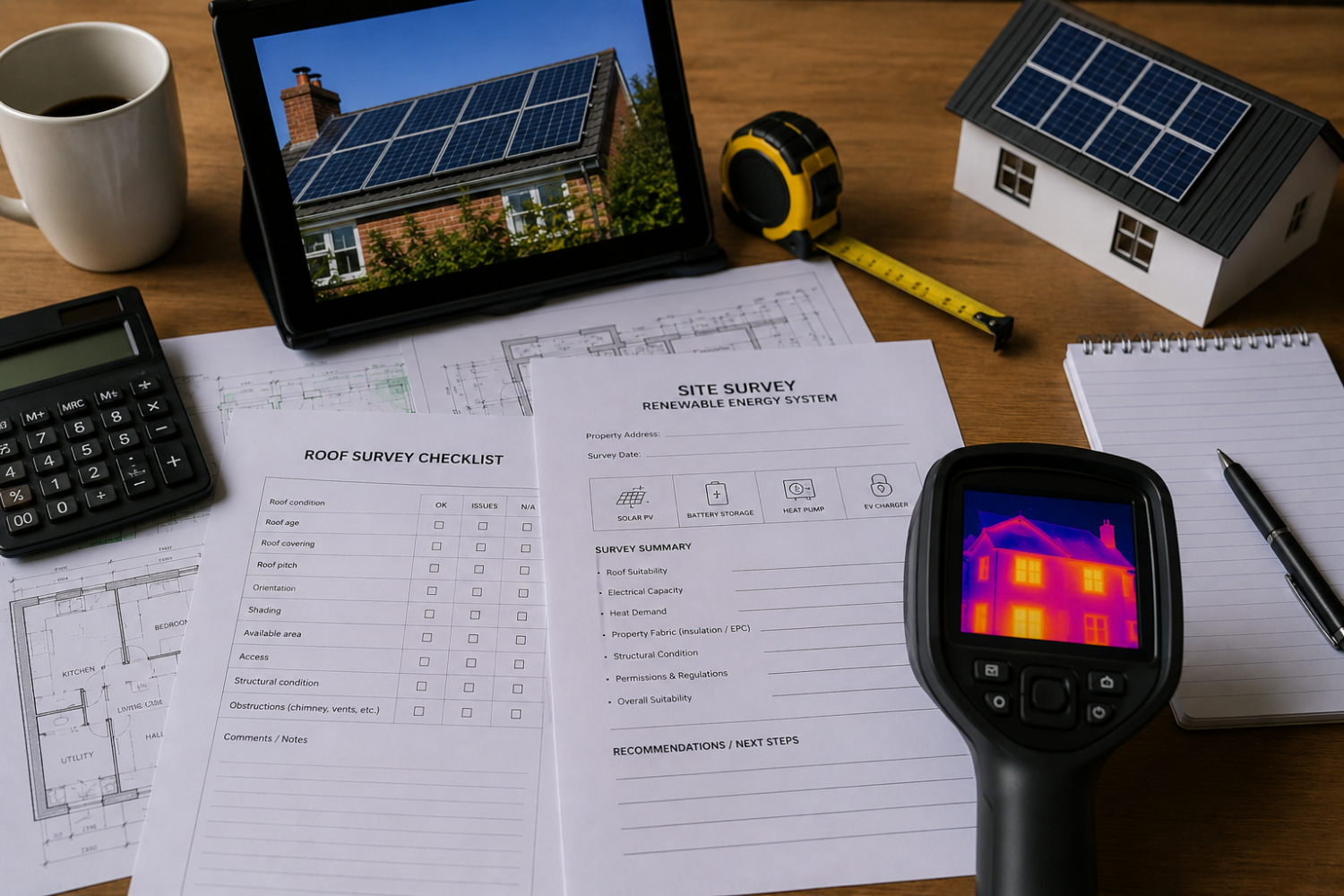
Before installing renewable energy systems, you may need a roof survey, electrical assessment, heat loss survey, EPC review, planning check, structural review, and sometimes a wider energy or decarbonisation assessment. The right surveys depend on the property, the technology being considered, and whether it is a home, rental property, commercial building, or agricultural site in areas such as Horley, Reigate, Redhill, Crawley, Surrey, or West Sussex.
This guide explains the main surveys and checks that may be needed before installing solar panels, battery storage, heat pumps, EV charging, or other renewable energy systems.
We’ll cover:
- Why surveys matter before installing renewable energy systems
- What renewable energy systems may need assessing
- Roof surveys for solar panels
- Electrical assessments
- Heat loss surveys for heat pumps
- EPC and energy performance reviews
- Structural and condition checks
- Planning, permissions, and paperwork
- Commercial and agricultural site surveys
- Common mistakes to avoid
- What happens after the surveys
- How JPEC Building Services can help
Why do surveys matter before installing renewable energy systems?
Surveys matter because renewable energy systems need to suit the building, not just the customer’s energy goals. A proper assessment helps confirm whether the property is suitable, what design is realistic, and what issues should be dealt with before installation.
Without the right checks, you may end up with a system that is poorly sized, difficult to install, less efficient than expected, or unsuitable for the building.
For example, a solar PV system may look simple on paper, but the roof condition, roof angle, shading, electrical capacity, and building use can all affect whether it is a sensible option. Solar PV means solar photovoltaic panels, which generate electricity from daylight.
JPEC Building Services can help assess the building first, so decisions are based on practical evidence rather than assumptions.
What renewable energy systems may need a survey?
Most renewable energy systems should be assessed before installation. The level of survey depends on the technology, the property, and the scale of the project.
Common systems that may need pre-installation checks include:
- solar PV panels
- battery storage
- air source heat pumps
- ground source heat pumps
- EV charging points
- solar thermal systems
- energy management systems
- hybrid systems combining more than one technology
A homeowner in Reigate may only need a roof survey and electrical assessment before installing solar panels. A commercial site in Crawley may need a more detailed building energy assessment, roof condition report, electrical capacity review, and decarbonisation plan.
Agricultural sites can be more complex because barns, workshops, farm offices, cold stores, grain stores, and rural dwellings may all have different building uses and energy demands.
Do I need a roof survey before installing solar panels?
Yes, you should usually have a roof survey before installing solar panels. The survey helps confirm whether the roof is suitable, safe, and practical for the proposed system.
A roof survey looks at the condition, size, shape, angle, orientation, access, shading, and available space. It may also consider whether there are rooflights, chimneys, vents, fragile materials, or other restrictions.
For homes in Horley, Redhill, or Reigate, this might involve checking tiled roofs, extensions, garages, and shading from nearby trees or buildings. For commercial or agricultural buildings in Surrey and West Sussex, it may involve larger roof areas, metal sheeting, asbestos risk, access limitations, drainage, or structural concerns.
A roof that looks suitable from the ground may still need further checks before panels are installed. JPEC Building Services can provide roof surveys for solar suitability and explain the practical options clearly.
Do I need a structural assessment?
You may need a structural assessment if there is any concern about whether the roof or building can safely support the proposed renewable energy system. This is especially important for larger solar arrays, older buildings, flat roofs, commercial roofs, and agricultural structures.
Solar panels add weight to a roof. The weight is usually manageable on many properties, but this should not be assumed. Wind loading, roof age, fixings, roof material, and the condition of the structure all matter.
A structural assessment may be more likely if:
- the roof is old or in poor condition
- the building is commercial or agricultural
- the proposed solar array is large
- the roof has lightweight construction
- there are signs of movement, sagging, damage, or corrosion
- the installation is on a flat roof with ballast
A proper survey can help identify whether further structural advice is needed before installation work begins.
Do I need an electrical assessment?
Yes, an electrical assessment is usually needed before installing solar panels, battery storage, EV charging, or heat pumps. These systems connect to the property’s electrical installation, so the existing supply and equipment need to be checked.
The assessment may look at the consumer unit or distribution board, earthing, available capacity, cable routes, protective devices, metering, and where new equipment could be installed.
For a domestic property, this may include checking whether the fuse board is suitable and whether upgrades are needed. For a commercial building, workshop, or farm, the assessment may be more detailed because there can be larger loads, three-phase supplies, multiple buildings, or older electrical infrastructure.
DNO approval may also be relevant. DNO stands for Distribution Network Operator, which is the company responsible for the local electricity network. Some renewable systems need notification or approval before connection, depending on the size and type of installation.
Do I need a heat loss survey before installing a heat pump?
Yes, a heat loss survey is strongly recommended before installing a heat pump. A heat pump needs to be sized carefully so it can heat the property properly without being inefficient or unsuitable.
A heat loss survey looks at how much heat the property loses through walls, floors, roof, windows, doors, draughts, and ventilation. In simple terms, it helps show how much heating power the building needs.
This is especially important for older homes in Reigate or Redhill, rural properties in West Sussex, and larger homes or buildings with uneven heating. If the building loses heat quickly, a heat pump may still be possible, but insulation, radiator sizing, controls, or other improvements may need to be considered first.
JPEC Building Services can carry out heat loss surveys and explain what the results mean before a heating system is designed.
Should I check my EPC before installing renewables?
Yes, it is often useful to check your EPC before installing renewable energy systems. An EPC, or Energy Performance Certificate, gives a property an energy efficiency rating and recommendations for improvement.
An EPC can help show how the building currently performs and what upgrades may support better energy efficiency. For landlords, it can also be important for rental compliance. For homeowners, it can help identify whether insulation, heating, glazing, or controls should be reviewed before or alongside renewable technologies.
However, an EPC should not be treated as a full design document. It is a useful starting point, but solar panels, heat pumps, batteries, and EV chargers should still be assessed properly through surveys and system design.
For properties across Surrey and West Sussex, JPEC Building Services can connect EPC surveys with wider building energy efficiency advice where appropriate.
Do I need a condition report before installing renewables?
A condition report may be useful if the property is older, complex, commercial, agricultural, or has visible building issues. It helps identify whether the building is in suitable condition before new systems are added.
A condition report can look at parts of the building that may affect installation, performance, safety, or long-term reliability. This could include roof condition, access, damp issues, fabric condition, ventilation, or general building suitability.
For example, installing solar panels on a roof that may need replacing soon can create avoidable cost and disruption. Similarly, fitting new technology to a poorly performing building may not produce the expected benefit if the underlying issues are not addressed.
JPEC Building Services can help identify where a condition report or further inspection may be sensible before committing to installation.
What planning, permissions, and paperwork may be needed?
Some renewable energy systems may need planning checks, building regulations consideration, DNO paperwork, landlord consent, leaseholder consent, or other approvals. The exact requirements depend on the property, location, system size, and type of work.
For many homes, certain renewable installations may fall under permitted development, which means planning permission may not be needed if rules are met. However, this is not always the case. Listed buildings, conservation areas, flats, commercial premises, and agricultural sites may need more careful checking.
Paperwork may include:
- planning checks
- building regulations compliance
- DNO notification or approval
- structural information
- EPC information
- product and installation certification
- landlord or freeholder permissions
- grid connection details for larger systems
It is better to check early than discover a restriction after design work or installation has started.
What surveys are needed for commercial or agricultural renewable projects?
Commercial and agricultural renewable projects often need more detailed surveys because the buildings, energy use, and installation scale can be more complex. A small home solar system is very different from a large roof-mounted array on a warehouse, workshop, barn, or farm building.
For a commercial site in Crawley, a survey may need to consider roof structure, electrical capacity, working hours, energy demand, distribution boards, access, health and safety, and future expansion.
For agricultural buildings in Surrey or West Sussex, the assessment may need to consider roof material, structural condition, grid connection, machinery loads, seasonal energy use, livestock areas, dust, moisture, ventilation, and the distance between buildings.
A decarbonisation report may also be useful. Decarbonisation means reducing the amount of carbon emissions linked to energy use. A report can help identify which improvements may form part of a wider plan, rather than looking at each technology separately.
What common mistakes should you avoid?
The biggest mistake is choosing a renewable energy system before properly understanding the building. A good installation starts with assessment, not just product selection.
Common mistakes include:
- assuming every roof is suitable for solar
- ignoring roof age or condition
- installing panels before checking shading
- choosing a heat pump without a heat loss survey
- overlooking electrical capacity
- missing DNO requirements
- treating EPC recommendations as a full design
- ignoring ventilation, comfort, or building fabric
- failing to plan access and maintenance
- focusing only on headline savings
Renewable technologies can be very effective, but only when they are properly assessed, designed, installed, tested, and commissioned.
JPEC Building Services can explain the trade-offs, likely performance, compliance requirements, and practical next steps in plain English.
What happens after the surveys?
After the surveys, the findings should help shape the design, budget, installation plan, and next steps. The aim is to move from a general idea to a realistic proposal that suits the property.
The outcome may show that the property is suitable for the chosen system. It may also show that some improvements should happen first, such as roof repairs, insulation upgrades, electrical work, heating changes, or further design checks.
For example, a homeowner in Horley may find that their roof is suitable for solar but needs shading considered. A landlord in Redhill may need to review EPC improvements first. A business in Crawley may need an electrical capacity assessment before installing EV chargers. A rural property in West Sussex may need a heat loss survey before a heat pump is designed.
The survey stage helps reduce surprises and supports better decision-making.
JPEC Building Services can help
JPEC Building Services are experienced local building compliance, energy performance, surveying, and sustainability specialists supporting homeowners, landlords, developers, commercial clients, agricultural sites, and business owners across Horley, Reigate, Redhill, Crawley, Surrey, West Sussex, and surrounding areas.
They can help assess, survey, calculate, report, advise, and support you properly, whether you need a roof survey for solar suitability, heat loss survey, EPC survey, condition report, sustainability report, decarbonisation report, SAP calculation, Predicted Energy Assessment, or wider compliance support before installing renewable energy systems.
As part of the wider JPEC Group, JPEC Building Services can help connect assessment, compliance, design, and delivery where appropriate. The aim is to explain trade-offs, building suitability, compliance requirements, likely performance, and practical next steps in plain English.
This article is general information only and is not personal advice. Recommendations should always be confirmed through a proper survey, inspection, assessment, calculation, or system design for the individual property and requirements.