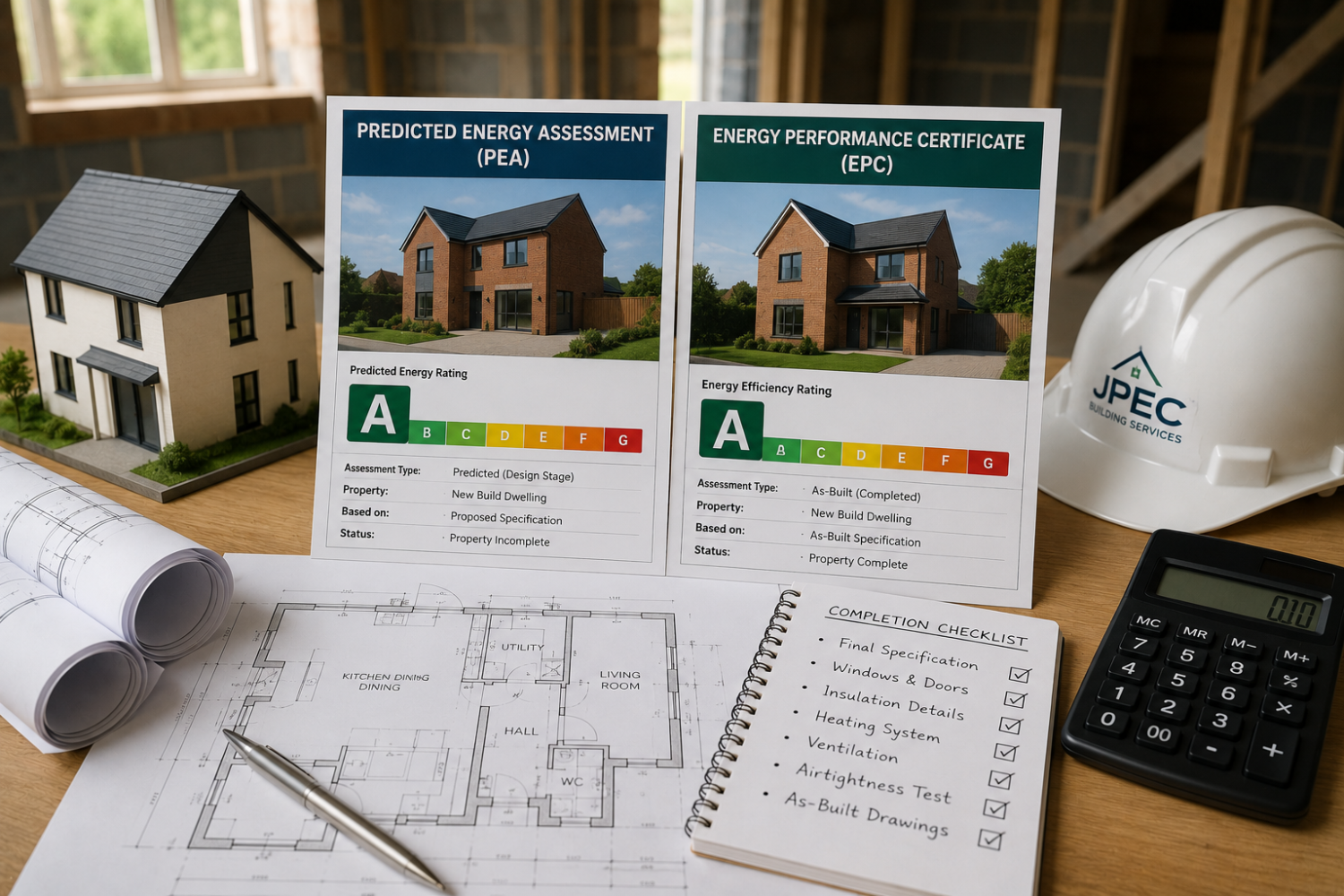
A Predicted Energy Assessment (PEA) shows the expected energy performance of a new home before it is completed, while the final Energy Performance Certificate (EPC) reflects the completed dwelling based on its as-built specification. They are closely related, but they are not the same document.
If you are building, developing or buying a new home in Horley, Reigate, Redhill, Crawley, Surrey or West Sussex, you may come across both documents during the project. This guide explains:
- What a Predicted Energy Assessment is
- What an EPC is
- The main difference between a PEA and EPC
- How SAP calculations relate to both
- When a PEA is produced
- Why the predicted rating can change
- What happens when construction is complete
- Why specification changes matter
- What information your energy assessor needs
- How to avoid problems at the end of a project
What is a Predicted Energy Assessment?
A Predicted Energy Assessment, usually shortened to PEA, provides an indication of the expected energy performance of a dwelling that has not yet been completed.
It is based on the proposed design and specification rather than a finished building.
The assessment can therefore take account of details such as the proposed walls, roof, floor, windows, heating system, ventilation and other energy-related features.
The key word is predicted. The rating represents how the dwelling is expected to perform if it is constructed in accordance with the information used for the assessment.
What is an EPC?
An Energy Performance Certificate, or EPC, provides an energy-efficiency rating for a property.
For a newly constructed dwelling, the final certificate is based on the completed property’s as-built information rather than simply the original design intention.
The familiar EPC scale runs from A to G, with A representing higher energy efficiency and G representing lower energy efficiency.
An EPC is designed to give owners, buyers and occupiers information about the energy performance of the property in a consistent format.
What is the main difference between a PEA and an EPC?
The simplest difference is the stage of the building project.
A PEA relates to the dwelling while it is still incomplete. The final EPC relates to the completed dwelling.
A PEA might therefore say, in effect, “this is how the proposed home is predicted to perform based on the current design”.
The final assessment asks a different question: “what was actually built?”
This distinction matters because construction projects do not always finish with exactly the same specification that was originally proposed.
Is a PEA the same as a SAP calculation?
No, although the two are closely connected.
SAP stands for Standard Assessment Procedure. It is the methodology used to assess the energy performance of dwellings for relevant Building Regulations and energy-certification purposes.
The SAP assessment contains considerably more technical information than the simple energy-rating graphic that most people associate with an EPC.
A PEA can be produced from the design-stage energy assessment for an incomplete dwelling.
The SAP work therefore sits behind the energy-performance information rather than the terms “SAP” and “PEA” simply meaning the same document.
When is a Predicted Energy Assessment produced?
A PEA is relevant while a new dwelling is still incomplete.
It provides a predicted energy rating based on the proposed specification and can be used where energy-performance information is needed before the finished EPC exists.
For a new development in Crawley, for example, the dwellings may still be under construction when energy-performance information is required.
At that stage there is no completed home on which to base the final certificate, so the assessment necessarily relies on the proposed design.
What information is used for the predicted assessment?
The assessment can require detailed information about the proposed dwelling.
Depending on the project, this can include:
- floor plans and dimensions
- wall construction
- roof construction
- floor construction
- insulation specifications
- window and door performance
- thermal bridging
- airtightness assumptions
- heating and hot-water systems
- ventilation
- lighting
- renewable technologies
Accurate information is important because the output is only as reliable as the design information on which it is based.
Can the PEA rating be different from the final EPC?
Yes. A predicted rating does not guarantee that the final EPC will show exactly the same result.
The final property may differ from the original design.
For example, changes might be made to glazing, insulation, heating equipment, ventilation, renewable technology or other parts of the specification.
Even apparently small substitutions can sometimes affect the energy assessment.
A PEA itself makes clear that the predicted energy rating may not represent the final rating once the property has been completed. :contentReference[oaicite:1]{index=1}
Why do construction changes matter?
Energy calculations are based on a combination of building-fabric and building-services information.
If a product or construction detail changes, the assumptions used in the original calculation may no longer be correct.
Consider a developer who changes the windows after the original energy assessment because an alternative product is available more quickly.
If the replacement windows have different thermal or solar characteristics, the energy calculation may need to reflect the revised specification.
The same principle applies to insulation, heating systems, ventilation and other energy-related components.
What is an as-built SAP assessment?
The design-stage assessment is based on what is intended to be constructed.
The as-built assessment reflects what has actually been installed in the completed dwelling.
This is an important part of the completion process because the finished property needs to be assessed using its final specification.
Information gathered during construction can therefore become important when the assessment is updated.
Good record keeping throughout the build makes this process much easier than trying to reconstruct every specification once the project is finished.
What evidence should be kept during construction?
The exact evidence required depends on the project, but developers should maintain clear records of the products and construction details actually used.
Useful records can include:
- final drawings
- insulation specifications
- window and door information
- heating-system details
- ventilation-system information
- renewable-energy equipment specifications
- airtightness results where applicable
- relevant product documentation
If the specification changes, those changes should be communicated to the appropriate designer or energy assessor rather than being discovered at the very end of the project.
Why should the energy assessor be involved before completion?
Leaving all energy-performance work until the building is finished can create unnecessary risk.
If the final assessment identifies that the completed specification does not achieve the required result, the available solutions may be more expensive or disruptive than they would have been during design.
Early assessment allows the proposed fabric and building services to be reviewed while changes can still be incorporated efficiently.
Keeping the assessment updated as important design decisions change can also reduce surprises at completion.
This is particularly valuable on developments containing several similar dwelling types because one specification change can affect multiple properties.
Does a good PEA guarantee Building Regulations compliance?
No single energy-rating document should be treated as proof that every aspect of a building complies with the Building Regulations.
Energy performance is only one part of the wider regulatory framework.
New dwellings can also have requirements relating to structure, fire safety, ventilation, overheating, electrical safety, drainage and other areas depending on the project.
The energy assessment itself also contains more detailed compliance information than the headline A-to-G rating alone.
A high predicted energy rating should therefore not be confused with complete Building Regulations approval.
Is the highest EPC rating always the design target?
Not necessarily.
Building Regulations establish minimum performance requirements, while a client or developer may choose to target performance beyond those minimum requirements.
Some projects may have additional sustainability objectives, planning conditions, client requirements or operational targets.
For example, a development may intentionally incorporate higher levels of fabric performance, heat pumps, solar PV or other measures as part of a wider low-energy strategy.
The appropriate target should be agreed for the particular project rather than assuming every development has exactly the same objective.
Can renewable technology improve the predicted energy performance?
Renewable and low-carbon technologies can affect a dwelling’s calculated energy performance, but they should be considered as part of the whole building design.
Solar PV, heat pumps and other technologies do not remove the need for appropriate insulation, airtightness, ventilation and building-fabric design.
JPEC Building Services can assess the building fabric and services together so proposed energy measures are reflected properly within the overall design.
Where appropriate, the wider JPEC Group can also coordinate building-performance work with the electrical and green-energy systems being considered for the project.
What happens when the property is completed?
Once the dwelling is complete, the energy assessment is updated using the final as-built specification and the required final energy-performance documentation can be produced.
The final EPC then provides information about the completed property rather than the earlier prediction.
This is why the PEA should not simply be handed to the eventual owner and treated as though it were the final certificate.
Published PEA documentation itself explains that once the property is completed, the rating is updated and an official EPC is created for the finished property.
How can developers avoid problems at the end of the build?
The simplest approach is to treat energy performance as an ongoing design and construction issue rather than paperwork to be dealt with at completion.
Good practice includes:
- obtaining the design-stage assessment early
- using accurate construction specifications
- communicating product substitutions
- keeping evidence during construction
- reviewing significant design changes
- coordinating airtightness and other required testing
- providing accurate as-built information promptly
This allows potential issues to be identified while there is still time to resolve them sensibly.
JPEC Building Services can help
JPEC Building Services supports homeowners, developers, architects and property professionals with energy-performance and building-compliance work across Horley, Reigate, Redhill, Crawley, Surrey and West Sussex.
We can provide and coordinate SAP calculations, Predicted Energy Assessments and the information required as a project progresses from initial design towards its completed energy assessment.
Our wider building-performance services can also include Part O overheating assessments, heat-loss calculations, thermal-performance advice and other property assessments where appropriate.
By considering energy performance early, we can help identify design issues before they become expensive construction problems and explain the results in straightforward language.
As part of the wider JPEC Group, building-performance work can also be coordinated with relevant building, electrical and green-energy requirements where appropriate.
To discuss the energy-performance requirements for your project, contact JPEC Building Services.
This article provides general information and is not project-specific Building Regulations, SAP or energy-performance advice. Requirements and assessment methodologies depend on the project, its regulatory circumstances and the stage of construction. The appropriate documentation should be confirmed for the individual development.