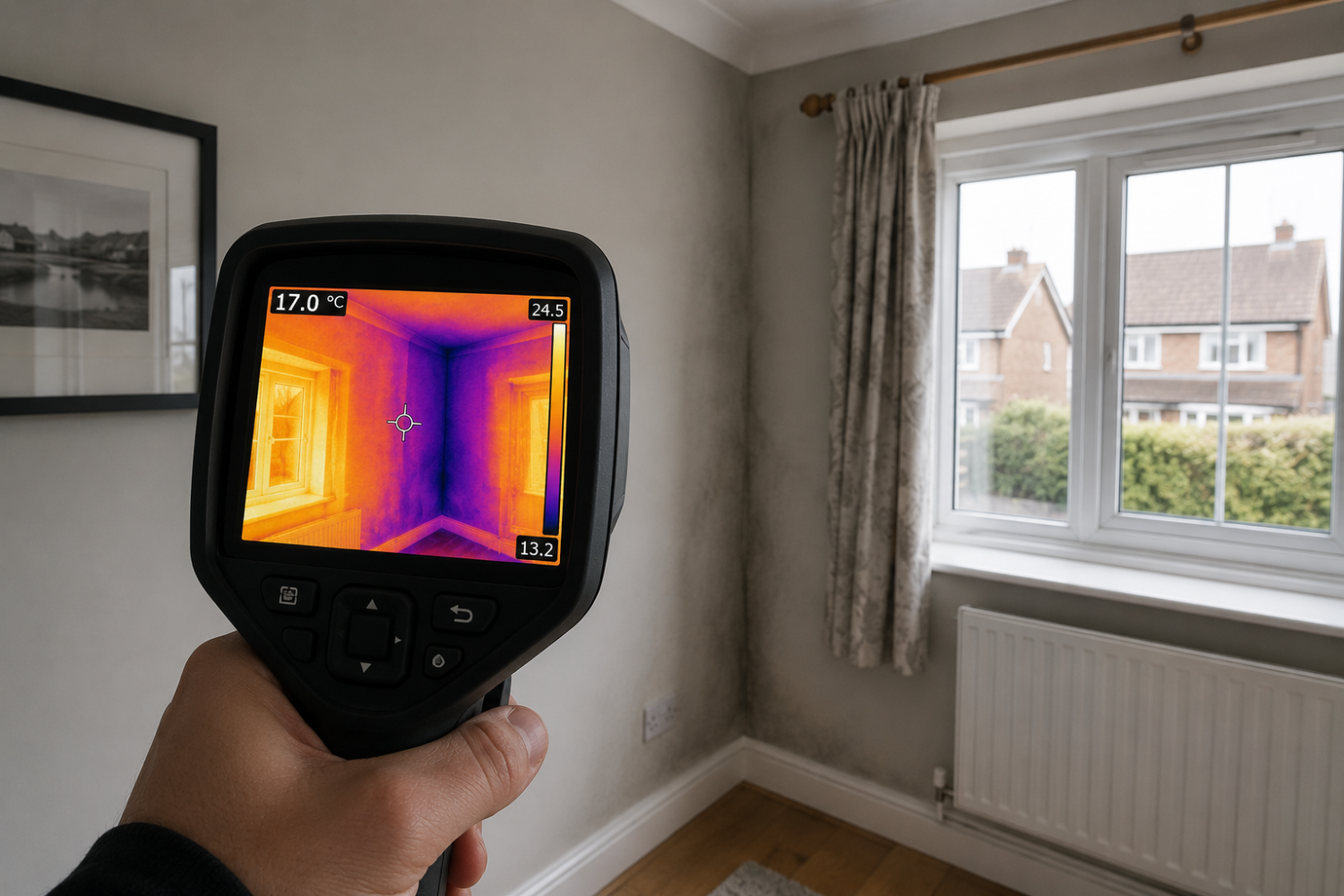
A thermal imaging survey uses a specialist infrared camera to show differences in surface temperature around a building. When carried out under suitable conditions and interpreted correctly, it can help identify unusual cold areas, possible insulation gaps, thermal bridging, draught patterns and other areas that may need further investigation.
However, a thermal camera cannot see through walls and a colourful image does not automatically prove that insulation is missing. For homeowners, landlords and property managers across Horley, Reigate, Redhill, Crawley, Surrey and West Sussex, this guide explains:
- What thermal imaging actually shows
- How a thermal imaging camera works
- What different colours mean
- Whether it can find missing insulation
- Whether it can detect draughts
- How it can help investigate thermal bridging
- Whether it can find damp
- Why weather conditions matter
- When a thermal imaging survey is most useful
- What should happen after the survey
What is a thermal imaging survey?
A thermal imaging survey uses an infrared camera to measure and display differences in surface temperature.
Instead of producing an ordinary photograph, the camera creates a thermal image showing warmer and cooler surfaces across the area being inspected.
This can help a building professional identify temperature patterns that would be difficult or impossible to see with the naked eye.
For example, a section of an external wall that is noticeably colder than the surrounding area may justify further investigation.
The important point is that thermal imaging provides information about surface temperatures. The results then need to be interpreted in the context of the building.
Can a thermal camera see through walls?
No. This is one of the most common misunderstandings about thermal imaging.
A thermal camera does not provide an X-ray view through walls, ceilings or floors.
It measures infrared radiation from the surfaces visible to the camera and uses that information to represent their apparent temperatures.
If insulation is missing behind plasterboard, for example, that defect may sometimes affect the temperature of the visible wall surface enough to create a recognisable pattern.
The camera is detecting the resulting surface-temperature difference, not directly seeing the insulation behind the wall.
What do the colours on a thermal image mean?
The colours represent different apparent surface temperatures within the temperature scale being displayed.
Depending on the camera settings, warmer areas might appear as yellow, orange or white while cooler areas might appear as blue, purple or black.
However, you should not assume that a particular colour always means a particular problem.
The colour palette and temperature range can be changed by the person using the camera. The same surface could therefore appear differently depending on how the image is configured.
The actual temperature data and pattern are more important than simply looking for a particular colour.
Can thermal imaging find missing insulation?
Thermal imaging can sometimes help identify patterns consistent with missing, displaced or poorly fitted insulation.
For example, if most of a wall is insulated consistently but one area has a significant gap, that section may have a different internal surface temperature during suitable survey conditions.
Similar patterns can sometimes appear in loft ceilings, sloping roofs and areas around structural elements.
However, the image alone does not prove that insulation is missing.
Construction details, weather conditions, heating patterns, moisture, air movement and other factors can all affect surface temperature.
Further investigation may therefore be needed before deciding on remedial work.
Can a thermal camera find draughts?
Thermal imaging can sometimes help locate the effects of unwanted air leakage, particularly where cold outside air is affecting nearby internal surfaces.
Potential areas can include:
- window and door frames
- loft hatches
- service penetrations
- skirting and floor junctions
- poorly sealed construction joints
- openings around pipes or cables
However, a thermal camera does not directly measure airflow.
If detailed airtightness information is required, other assessment methods may be more appropriate.
Thermal imaging should therefore be treated as one diagnostic tool rather than a replacement for every other form of building assessment.
Can thermal imaging identify thermal bridging?
It can be very useful for investigating possible thermal bridges.
A thermal bridge is an area where heat passes through the building construction more readily than through the surrounding fabric.
These areas can create lower internal surface temperatures during colder weather.
Thermal images may reveal regular patterns around:
- external corners
- window and door openings
- wall-to-floor junctions
- wall-to-roof junctions
- lintels
- structural elements
The pattern still needs to be interpreted alongside knowledge of the building construction.
A colder area does not automatically mean there is a defect. Some temperature variation may be expected because of the way the building has been constructed.
Can a thermal camera detect damp?
Thermal imaging can sometimes highlight temperature patterns that may be associated with moisture, but it does not directly measure whether a material is wet.
Moisture can affect surface temperatures because evaporation and changes in thermal behaviour may make an area appear different from surrounding materials.
However, a cool patch on a thermal image could have several possible causes.
It might relate to insulation, air leakage, construction details, shading or moisture.
If damp is suspected, the thermal image should normally be considered alongside visual inspection and appropriate moisture investigation rather than being treated as proof on its own.
Can thermal imaging help investigate condensation and mould?
Yes, particularly when the purpose is to understand why particular internal surfaces are becoming unusually cold.
Condensation risk increases when warm, moisture-containing indoor air meets a sufficiently cold surface.
If mould repeatedly develops around a window reveal or external corner, thermal imaging may help show whether that area is significantly colder than the surrounding construction.
That information can be useful, but the wider conditions still matter.
Indoor humidity, ventilation, heating patterns, occupancy and building defects should all be considered before deciding what is causing the problem.
Why does the weather matter during a thermal imaging survey?
Thermal imaging becomes much more useful when there is a suitable temperature difference between inside and outside.
If the internal and external temperatures are very similar, defects may produce only small surface-temperature differences and become much harder to identify.
This is one reason building thermal imaging is often particularly useful during cooler weather when the property is being heated.
External surveys can also be affected by:
- direct sunlight
- recent solar heating
- rain
- strong wind
- rapidly changing temperatures
A wall that has been heated by the sun, for example, may produce a thermal pattern that has little to do with heat escaping from inside the building.
Good survey conditions and experienced interpretation are therefore important.
Does the heating need to be on before the survey?
Often, yes. If the purpose of the survey is to investigate heat loss or insulation performance, having a stable difference between indoor and outdoor temperature can make useful patterns easier to identify.
Turning the heating on immediately before the camera arrives is not necessarily enough.
The building needs time to respond thermally, and the appropriate preparation depends on what is being investigated.
JPEC Building Services can advise on any preparation required before the assessment so the survey is carried out under useful conditions.
Can thermal imaging tell me exactly how much heat my house is losing?
No. A thermal image and a heat-loss calculation are different things.
Thermal imaging is useful for visualising surface-temperature differences and identifying areas that may need further investigation.
A heat-loss calculation uses information about the size and construction of the building, insulation, windows, doors, ventilation and design temperatures to calculate heating requirements.
Thermal imaging can therefore support a wider building-performance investigation, but it should not be treated as a substitute for a proper heat-loss calculation where one is required.
Can it show why one room is colder than another?
It may help identify part of the reason, particularly if one room has obvious cold surfaces, insulation irregularities or unusual temperature patterns.
However, room comfort depends on much more than the walls.
A colder room could also be affected by:
- radiator or heating output
- heating controls
- window area
- external exposure
- ventilation
- air leakage
- room size
- building orientation
For example, a north-facing bedroom in an older Reigate property may behave differently from a south-facing living room even if both are heated at the same time.
The thermal images need to be considered as part of the wider building.
Is thermal imaging useful before buying insulation?
It can be useful where you are trying to understand an existing building before committing to significant improvements.
One of the risks with energy-efficiency work is assuming you already know where the problem is.
A homeowner might believe a cold room simply needs more loft insulation when the main weakness is actually somewhere else in the building fabric.
Thermal imaging may help focus further investigation, but the appropriate improvement should still be based on the construction and condition of the property.
This is particularly important in older buildings where changes to insulation can also affect moisture and ventilation.
Is thermal imaging useful for new-build properties?
Yes. Thermal imaging can also be useful when investigating the quality and consistency of completed building fabric.
Under suitable conditions, unusual temperature patterns may help identify areas that deserve closer inspection.
This can be relevant around insulation, junctions, windows, doors and other parts of the thermal envelope.
However, thermal imaging is not automatically a Building Regulations compliance test and should not be confused with assessments such as SAP calculations or air-pressure testing.
Each assessment answers a different question about the building.
What are the limitations of a thermal imaging survey?
The biggest limitation is that thermal images can be easy to misinterpret.
A cold area is evidence of a surface-temperature difference, not an automatic diagnosis.
Results can be influenced by:
- weather conditions
- heating conditions
- reflections from certain surfaces
- different construction materials
- sunlight
- air movement
- moisture
- furniture and coverings
This is why buying a thermal camera and looking for blue patches is not the same as carrying out a building-performance assessment.
The value comes from combining the images with an understanding of how the property is constructed and how it is behaving.
What happens after a thermal imaging survey?
The next step depends on what the survey finds.
Some results may simply confirm expected construction patterns. Others may justify further investigation or more detailed assessment.
This might include reviewing insulation, checking ventilation, investigating moisture, assessing airtightness or completing a heat-loss calculation.
The important thing is not to jump straight from a thermal image to expensive remedial work.
For a property in Horley, Redhill or Crawley, the most cost-effective outcome may sometimes be a relatively targeted improvement rather than a major refurbishment.
A good assessment should help narrow down the problem and determine what evidence is needed next.
JPEC Building Services can help
JPEC Building Services can help homeowners, landlords, developers and property professionals investigate building-performance issues across Horley, Reigate, Redhill, Crawley, Surrey and West Sussex.
Where appropriate, thermal imaging can form part of a wider assessment of heat loss, insulation, cold surfaces, thermal bridging and building-fabric performance.
Rather than treating a thermal image as an answer on its own, we can consider the results alongside the property’s construction, condition and intended improvements and explain what further investigation may be worthwhile.
JPEC Building Services can also support projects with heat-loss assessments, SAP calculations, EPCs, overheating assessments, condition reports and wider building-performance work where appropriate.
As part of the wider JPEC Group, assessment findings can also be coordinated with building, electrical and green-energy work where required.
To discuss a thermal or building-performance assessment for your property, contact JPEC Building Services.
This article provides general information and is not property-specific building, damp, insulation or energy advice. Thermal imaging identifies surface-temperature patterns and does not by itself confirm the cause of a building defect. Recommendations should be based on an appropriate survey, assessment and investigation of the individual property.