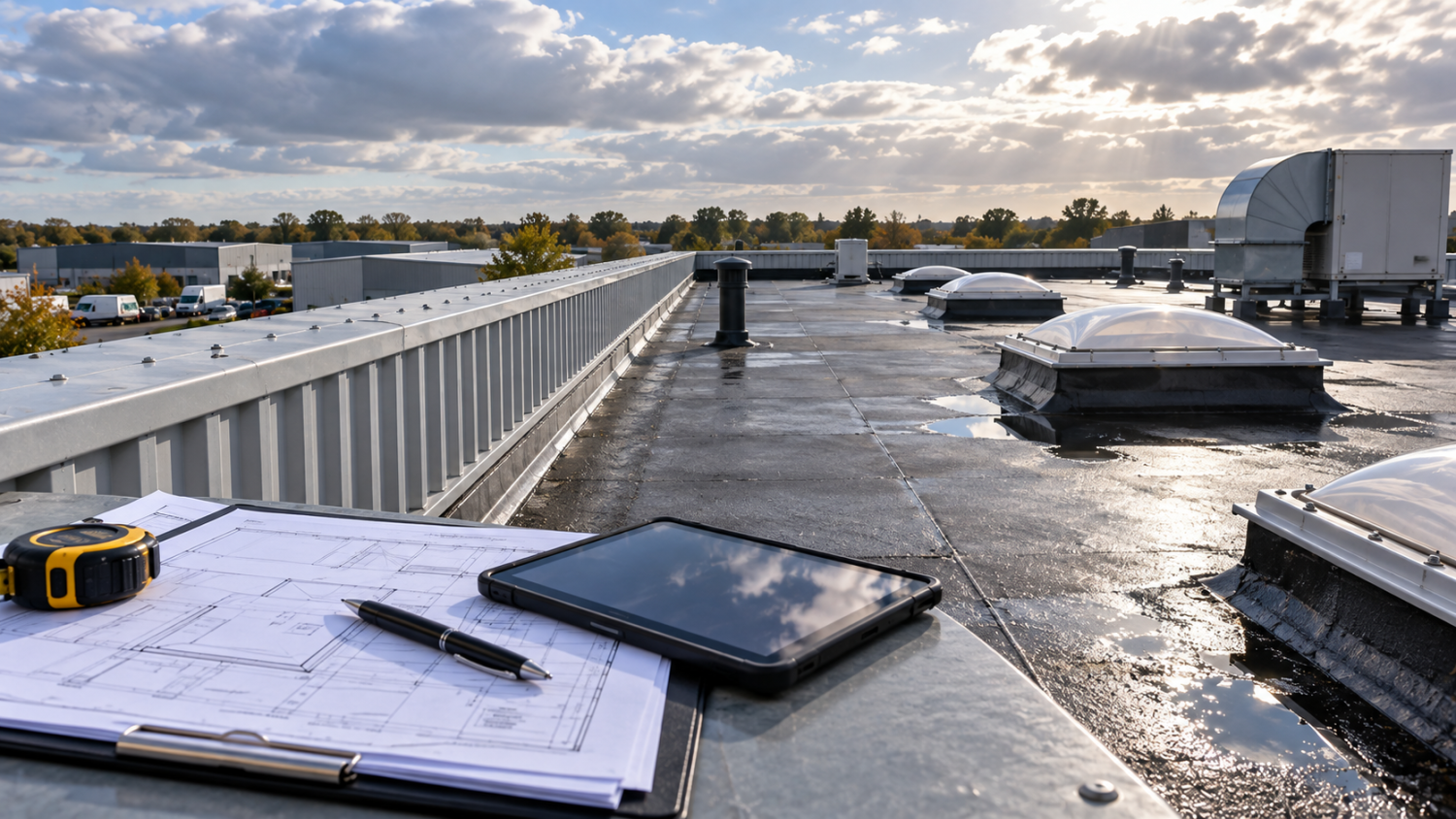
A commercial roof survey assesses the condition of a roof and helps identify visible defects, deterioration, water-ingress risks and areas that may require repair or further investigation. It can be particularly useful before refurbishment, major maintenance, property investment or changes that could affect the roof.
The level of assessment depends on the building, roof construction and reason for the survey. A large industrial unit in Crawley may require a very different approach from a small office, community building or agricultural property elsewhere in Surrey or West Sussex.
This guide explains:
- What a commercial roof survey is
- When you might need one
- What areas are normally assessed
- How flat and pitched roofs differ
- How water ingress and drainage are considered
- Why roof age does not tell the whole story
- What access limitations can affect a survey
- When structural assessment may also be required
- How roof surveys help with refurbishment planning
- How JPEC Building Services can help
What is a commercial roof survey?
A commercial roof survey is an assessment of the condition of the roof covering and other accessible roof elements.
The objective is to understand what condition the roof is currently in, identify visible problems and provide useful information for future decisions.
Depending on the scope, this could involve a warehouse, office, workshop, retail property, community building, industrial unit or agricultural building.
The survey should be appropriate to the roof itself. Different materials, construction methods, ages and access arrangements create different inspection requirements.
When should you get a roof survey?
You do not necessarily need to wait until water starts entering the building.
A roof survey may be useful:
- before major refurbishment
- when recurring leaks are being reported
- before committing to significant roof repairs
- when planning future maintenance budgets
- when an older roof is showing deterioration
- before certain new equipment or installations are added
- when assessing a commercial property portfolio
- following significant damage or deterioration
Understanding the roof earlier can help a property owner make a planned decision rather than responding only when a failure becomes urgent.
What does a roof survey actually check?
The precise inspection depends on the roof, but the survey may consider the condition of accessible elements including:
- roof coverings
- membranes
- tiles or slates
- sheet roofing
- flashing and weathering details
- rooflights
- gutters and outlets
- visible penetrations
- upstands and edges
- junctions between different materials
- signs of previous repairs
- visible deterioration or damage
Where internal areas are accessible, evidence such as staining or water ingress may also help build a clearer picture of the roof’s condition.
What are common problems found on commercial roofs?
Commercial roofs can deteriorate in different ways depending on their construction, exposure and maintenance history.
Problems may include damaged coverings, failed seals, deteriorated flashing, blocked drainage, damaged rooflights, corrosion, standing water or defects around penetrations.
Previous repair work is also worth considering. A roof containing numerous local patches may indicate a history of recurring problems even if it is not leaking at the exact time of the inspection.
The significance of each observation needs to be considered in the context of the whole roof.
Are flat roofs more difficult to assess?
Flat and low-pitched roofs have different characteristics from traditional pitched tiled roofs.
Drainage is particularly important because water needs to reach the intended outlets without remaining unnecessarily on the roof.
The condition of membranes, joints, edges, outlets, rooflights and penetrations may all be relevant.
Some standing water after rainfall does not automatically prove that the roof has failed, but persistent ponding can justify further investigation depending on the roof system and circumstances.
The inspection needs to consider the actual roof rather than applying the same assumptions to every flat-roof construction.
What about pitched commercial roofs?
Pitched commercial roofs can include tiles, slates, profiled sheets and various other systems.
A survey may consider displaced or damaged coverings, ridge and verge details, flashing, gutters, rooflights and visible signs of deterioration.
Older industrial and agricultural properties can require particular care because the roof construction and materials may differ substantially from a modern commercial building.
Access and safety requirements also influence how closely different areas can be inspected.
Can a roof survey find the cause of a leak?
It may help identify the likely source, but water ingress is not always straightforward.
The place where water appears inside the building is not necessarily directly below the external defect.
Water can travel along structural elements, membranes or other parts of the construction before becoming visible internally.
A survey may identify damaged coverings, failed details, blocked drainage or other possible routes for water ingress.
In some cases, further investigation may be necessary before the cause can be confirmed.
Why are gutters and roof drainage important?
A roof needs an effective way to remove rainwater.
Blocked or damaged gutters and outlets can allow water to accumulate or overflow into areas where it was never intended to go.
Leaves, vegetation, debris and general lack of maintenance can contribute to drainage problems.
For larger commercial roofs, a significant area can discharge towards a relatively small number of outlets, making drainage performance particularly important.
A roof assessment should therefore look beyond the main roof covering itself where drainage components fall within the agreed inspection scope.
Does an old roof automatically need replacing?
No. Age is useful information, but it does not determine condition on its own.
Two roofs of a similar age can be in very different condition depending on their materials, installation quality, exposure, maintenance and repair history.
Likewise, a newer roof can still develop defects.
The purpose of a condition assessment is to gather evidence about the actual roof rather than recommending replacement simply because a particular number of years has passed.
Where remaining service life cannot be established reliably, the report should make that uncertainty clear.
Can every part of the roof be inspected?
Not necessarily.
Safe access is one of the biggest practical considerations during a roof survey.
Some areas may be inaccessible because of height, fragile materials, roof geometry, weather conditions or other site restrictions.
The survey should clearly state any limitations.
It is important not to assume that an area has been inspected simply because it forms part of the same roof.
Where closer access is required, appropriate access arrangements and working-at-height controls need to be established.
Does a roof condition survey confirm structural capacity?
Not automatically.
A roof-condition inspection and a structural assessment answer different questions.
A condition survey may identify visible sagging, deformation, corrosion, cracking or other observations that justify further investigation.
However, determining whether a roof structure can safely support a particular additional load may require structural calculations and assessment by an appropriately qualified professional.
This distinction becomes particularly important when new plant, solar PV or other equipment is being considered.
Should you survey a roof before refurbishment?
It can be very useful.
If a commercial building is about to undergo significant refurbishment, understanding the roof condition can help the project team plan the work properly.
For example, there may be little benefit in refurbishing internal areas without first addressing an active water-ingress problem above them.
Likewise, if roof replacement is likely within the planned investment period, it may be sensible to coordinate other improvements with that work.
Early information can reduce the risk of discovering avoidable problems once the refurbishment is already underway.
Can a roof survey help with energy-efficiency improvements?
Yes, particularly where roof work is already being considered.
The roof forms part of the building’s thermal envelope, so its construction and insulation can influence heat loss and overall energy performance.
If a roof is due for significant refurbishment, it may be sensible to consider energy performance at the same time rather than viewing condition and efficiency as completely separate issues.
The applicable Building Regulations and technical requirements will depend on the nature and extent of the proposed work.
JPEC Building Services can support wider building-performance assessments where required.
What about solar panels?
A roof survey can be an important part of preparing an existing building for solar PV, but roof condition is only one consideration.
A solar project may also require assessment of the roof structure, available area, orientation, shading, proposed mounting system and electrical infrastructure.
If a roof is already approaching major repair or replacement, it may make sense to coordinate that work before or alongside the solar project.
This can reduce the likelihood of installing a long-term solar system and then having to remove it prematurely to carry out major roof work.
JPEC Building Services already provides separate guidance on the surveys that may be required before renewable-energy installations.
Can roof surveys help commercial landlords and property managers?
Yes. A roof can represent a significant future maintenance liability on a commercial property.
For landlords and property managers responsible for multiple buildings, condition information can help establish priorities.
One property may need relatively minor maintenance while another may justify more detailed investigation or planned capital works.
Recording roof condition can therefore contribute to a broader planned-maintenance strategy rather than relying entirely on reactive repairs.
What information should you provide before the survey?
Existing information can help establish the history of the roof and the reason for the assessment.
Useful information can include:
- building plans
- roof construction details
- previous survey reports
- maintenance records
- details of previous repairs
- locations of known leaks
- planned refurbishment work
- details of proposed roof-mounted equipment
It is also helpful to explain the decision the report is intended to support.
A survey investigating recurring water ingress may have a different focus from one being commissioned to support a five-year maintenance programme.
Does a roof survey include an asbestos survey?
No. A general roof survey should not be treated as an asbestos survey.
Some older commercial, industrial and agricultural buildings may contain asbestos-containing roofing or associated materials.
If asbestos is known or suspected, appropriate specialist assessment and management procedures may be required, particularly before intrusive work, refurbishment or demolition.
Suspected materials should not be disturbed simply to investigate the roof.
What happens after the roof survey?
The next step depends on what has been found and why the assessment was commissioned.
The findings may support routine maintenance, targeted repairs, further specialist investigation or a wider refurbishment strategy.
If additional works are being considered, the roof information can also be used alongside other assessments such as building condition reports, energy assessments, structural investigations or renewable-energy feasibility work.
The important point is that the survey provides information for a decision. It should not simply become another report that is produced and then ignored.
JPEC Building Services can help
JPEC Building Services provides roof surveys and wider building-condition and performance assessments for commercial organisations, landlords, property managers, developers and property owners across Horley, Reigate, Redhill, Crawley, Surrey, West Sussex and the wider South East.
We can assess the accessible condition of the roof, record relevant defects and deterioration, and explain where maintenance or further specialist investigation may be appropriate.
Where the roof assessment forms part of a larger project, JPEC Building Services can also support condition reports, EPC assessments, sustainability reports, decarbonisation planning, heat-loss calculations and other building-performance work.
As part of JPEC Group, we can also coordinate with JPEC Green Energy and JPEC Electrical where the project progresses into solar PV, electrical infrastructure or wider energy improvements.
To discuss a commercial roof survey or wider building assessment, contact JPEC Building Services.
This article provides general information and is not a substitute for a project-specific roof survey, structural assessment, asbestos survey or other specialist investigation. The appropriate inspection and assessment should be determined for the individual building and proposed works.