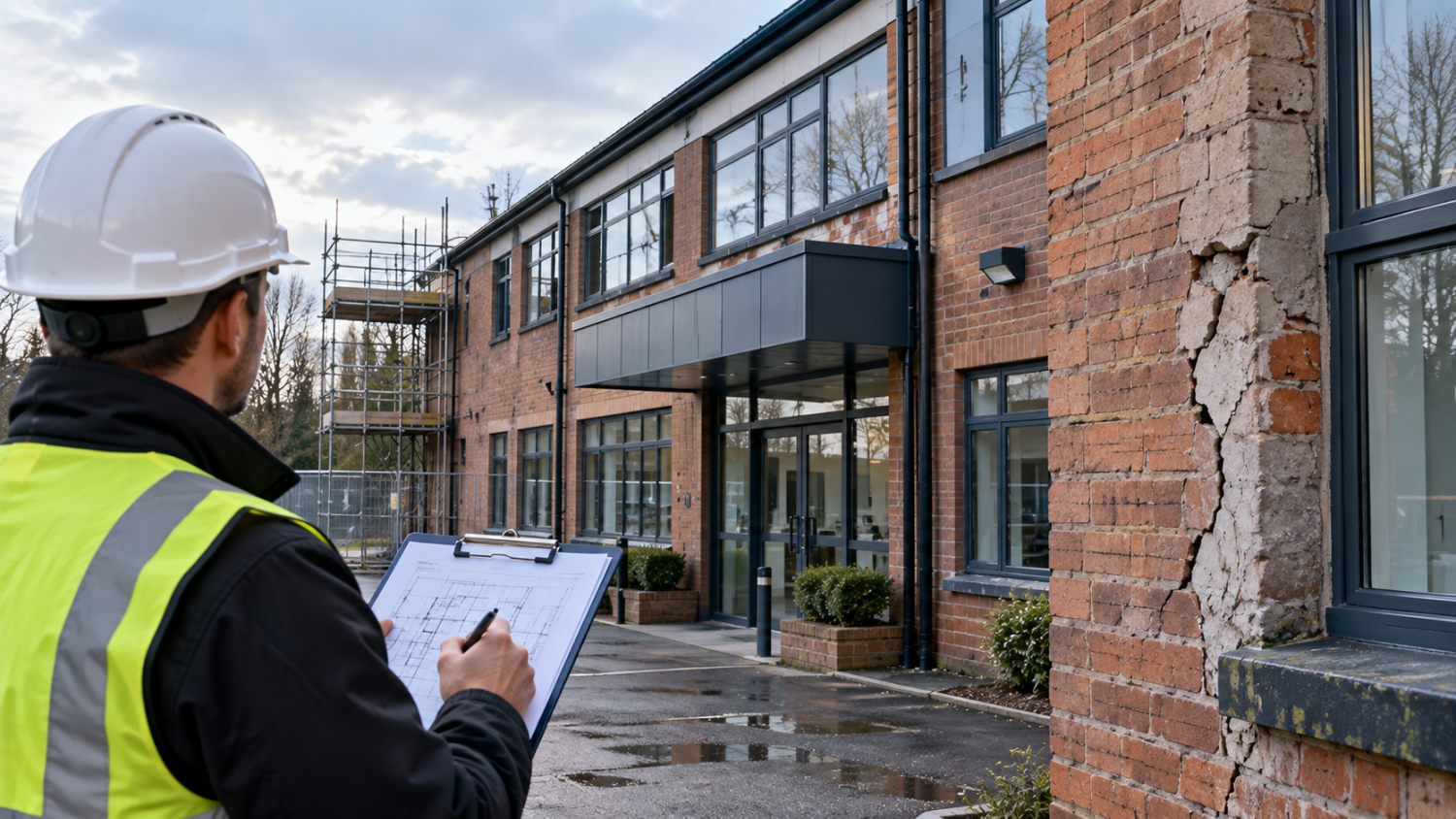
A building condition report records the visible condition of a property and helps identify defects, deterioration, maintenance issues and areas that may need further investigation. It can be particularly useful before buying, refurbishing, maintaining or making major changes to a commercial, residential or agricultural building.
The purpose is not simply to produce a list of everything that looks old. A useful condition assessment helps you understand which issues matter, what may require attention and where specialist investigation could be needed before money is committed to a project.
For property owners, landlords, businesses and organisations across Horley, Reigate, Redhill, Crawley, Surrey and West Sussex, this guide explains:
- What a building condition report is
- When you might need one
- What areas of a building can be inspected
- How defects are identified
- What the survey can and cannot tell you
- How condition reports help with refurbishment planning
- Why roofs and building fabric matter
- How energy performance can fit into the assessment
- When further specialist investigation may be required
- How JPEC Building Services can help
What is a building condition report?
A building condition report provides a structured assessment of the condition of a property at the time it is inspected.
The scope can vary considerably depending on the type of building and why the report has been commissioned.
For example, a landlord may want to understand the maintenance requirements of a commercial property. A business may be considering refurbishment of an older building. A property manager may need a clearer picture of several buildings before planning future expenditure.
The survey should therefore be agreed around the client’s objectives rather than treated as a one-size-fits-all inspection.
When might you need a building condition report?
A condition report can be useful whenever the physical condition of a building could influence an important decision.
Common reasons include:
- planning a refurbishment
- reviewing an ageing commercial property
- preparing a maintenance programme
- investigating visible deterioration
- considering energy-efficiency improvements
- planning renewable-energy installations
- assessing an agricultural or rural building
- reviewing a portfolio of properties
- planning future capital expenditure
The earlier existing defects are understood, the easier it can be to incorporate them into the wider project.
What does a building condition survey look at?
The exact inspection depends on the agreed scope and the type of property.
Relevant areas can include:
- roof coverings and visible roof condition
- external walls and cladding
- windows and external doors
- rainwater goods and drainage features
- internal walls and ceilings
- floors
- visible signs of damp or water ingress
- cracking or movement
- insulation where it can be established
- general condition of accessible building elements
- areas affected by previous alterations
Some projects may require additional specialist assessments beyond the general condition survey.
Does a condition report include the roof?
The roof can be one of the most important parts of a building condition assessment, particularly where it is ageing or where future work is planned.
The survey may consider visible aspects such as roof coverings, deterioration, damage, drainage, rooflights, penetrations and signs of previous repairs.
Access will affect how much can be inspected.
A roof that appears reasonable from ground level may still contain defects that cannot be confirmed without closer inspection.
Where a more detailed roof assessment is needed, JPEC Building Services can provide dedicated roof-survey support appropriate to the project.
Why does roof condition matter before installing solar panels?
Solar PV systems are intended to remain in place for many years, so installing panels onto a roof that is approaching major repair or replacement can create avoidable disruption later.
If the roof subsequently needs substantial work, panels may need to be removed and reinstated to provide access.
Condition is only one part of solar suitability. Structural capacity, roof construction, available area, orientation, shading and the proposed mounting system may also need to be considered.
JPEC’s existing renewable-energy survey guidance already explains that roof and structural checks can form an important part of preparing for solar installation.
Can a condition report identify structural problems?
A visual condition assessment may identify signs that could indicate a structural issue, but it should not automatically be treated as a full structural engineering assessment.
Visible warning signs could include significant cracking, deformation, movement, corrosion or sagging.
The significance of those observations depends on the building and the circumstances.
Where a potential structural issue is identified, further investigation by an appropriately qualified structural professional may be recommended.
A good condition report should be clear about the limits of the inspection rather than making conclusions that cannot be supported by the available evidence.
Can a building survey find hidden defects?
Not every defect can be identified during a visual, non-invasive survey.
Parts of the building may be concealed behind finishes, ceilings, floors, insulation or fixed equipment.
Access may also be restricted.
For example, the internal condition of a wall cavity cannot normally be confirmed simply by looking at the finished wall surface.
If observations suggest a concealed problem, the report may recommend further investigation.
This distinction is important because a condition report should describe what has actually been inspected and make any limitations clear.
Does a condition survey check for damp?
Visible signs of damp, staining, condensation, mould or water ingress may be recorded where they are observed.
However, identifying moisture does not automatically identify its cause.
Water can enter or accumulate in buildings for many reasons, including:
- roof defects
- failed rainwater goods
- plumbing leaks
- poor external detailing
- condensation
- inadequate ventilation
- ground moisture
- defects around windows and doors
Further investigation may therefore be needed before specifying remedial work.
Treating visible symptoms without understanding the source can result in money being spent without solving the underlying problem.
Can a condition report help before refurbishment?
Yes. This is one of the situations where understanding the existing building can be particularly valuable.
A refurbishment may involve new finishes, heating systems, windows, insulation, electrical installations or changes to the layout.
If existing defects are discovered only after work has started, the programme and budget may need to change.
A condition assessment before design is finalised can help identify obvious issues earlier.
It can also help the project team distinguish between items that are simply being modernised and areas where genuine repair or remedial work may be needed.
Can a condition report help plan maintenance?
Yes. For commercial property owners and organisations managing several buildings, condition information can support maintenance planning.
Not every defect requires immediate replacement.
Some items may require urgent attention, while others can be monitored or incorporated into future planned works.
A useful report can help establish priorities rather than treating every observation as equally important.
This can be especially useful when an organisation needs to plan expenditure across several financial years or across a larger property portfolio.
Can JPEC assess several buildings at once?
Yes. Condition assessments can be particularly useful for organisations responsible for multiple properties.
A portfolio might contain buildings of different ages, construction types and uses.
For example, a local authority or commercial organisation could be responsible for offices, workshops, depots, community buildings and other operational sites.
Using a consistent assessment approach can help build a clearer picture of where maintenance, refurbishment or further investigation should be prioritised.
Each property still needs to be considered individually because the risks and requirements can differ substantially.
What is the difference between a condition report and an EPC?
They assess different things.
An Energy Performance Certificate provides a standardised assessment of a building’s energy performance using an approved methodology.
A building condition report is focused on the physical condition of the property and the defects or maintenance issues identified within the agreed scope.
An EPC might indicate that a building could benefit from improved insulation or a different heating system, but it is not a detailed inspection of the condition of the roof, walls or other building elements.
Depending on the project, both pieces of information may be useful.
What is the difference between a condition report and a heat loss survey?
A heat loss survey focuses on how much heat a property loses and the factors influencing its heating requirement.
A condition report has a broader physical-condition focus.
For example, a condition survey may record deterioration to an external wall. A heat loss assessment may consider the thermal performance of that wall as part of calculating how much heat is being lost.
They answer different questions, although the findings from one assessment can sometimes influence another.
JPEC Building Services can advise which assessment is appropriate depending on what the client is trying to establish.
Does a condition report assess energy efficiency?
Energy-performance observations may be relevant, but a general condition report should not automatically be treated as a full energy assessment.
Visible insulation, glazing, building fabric and heating equipment may provide useful information, particularly if the building is being considered for refurbishment.
If the objective is specifically to understand energy performance, additional services such as an EPC, heat-loss assessment, sustainability report or decarbonisation assessment may be more appropriate.
The advantage of considering these areas together is that maintenance and energy improvements can sometimes be coordinated.
Why combine maintenance and energy improvements?
Some of the best opportunities arise when a building element already needs work.
For example, if a roof is approaching replacement, it may be sensible to consider insulation, future solar PV requirements and roof penetrations as part of the same project.
If windows are being replaced, ventilation and energy performance should also be considered.
If major heating equipment is approaching the end of its life, the organisation may want to investigate lower-carbon alternatives before simply replacing it like-for-like.
This does not mean every maintenance project needs to become a complete energy retrofit.
It means understanding the wider building can prevent missed opportunities.
Can a condition report help before installing a heat pump?
A condition report can provide useful background information, particularly for older or complex buildings, but it does not replace a proper heat-loss assessment and heating-system design.
Before a heat pump is specified, the building’s heating requirement needs to be understood properly.
Condition information may identify issues that deserve attention first, such as defective windows, water ingress or significant building-fabric problems.
JPEC Building Services can combine appropriate building assessments with detailed heat-loss work where a property is being prepared for a heat-pump project.
What should happen if the survey finds a serious problem?
The appropriate response depends on what has been identified.
Some issues may require straightforward maintenance. Others may need specialist investigation before the cause and appropriate repair can be established.
If there is a potential structural, asbestos, electrical, fire-safety or other specialist concern, the correct professional discipline may need to become involved.
A building condition survey should not pretend to replace every specialist inspection.
Its value is partly in identifying where additional expertise may be required before the project continues.
Does a condition report include asbestos?
A general building condition report should not be assumed to replace an asbestos survey.
Older commercial, industrial and agricultural buildings can contain materials that may require specialist asbestos assessment.
If asbestos-containing materials are suspected or if refurbishment work could disturb them, appropriate asbestos-management or refurbishment and demolition survey requirements should be considered separately.
The correct assessment depends on the building and the work being proposed.
Do not disturb suspected asbestos-containing materials simply to investigate their condition.
How long does a building condition report remain valid?
A condition report records the building at a particular point in time.
Buildings continue to age and their condition can change due to weather, occupation, leaks, accidental damage, maintenance and alterations.
There is therefore no universal period after which every condition report automatically becomes invalid.
How long it remains useful depends on the building, the findings and what the report is being used for.
If significant time has passed or the property has changed substantially, an updated inspection may be appropriate before important decisions are made.
What should you provide before the survey?
Existing information can help the surveyor understand the building and any known history.
Useful documents may include:
- building plans
- previous survey reports
- maintenance records
- details of known leaks or defects
- roof information
- previous refurbishment records
- EPCs and energy assessments
- details of planned works
You should also explain why the report is being commissioned.
A survey intended to support a major refurbishment may need a different focus from one intended primarily to support routine maintenance planning.
What happens after the condition survey?
The next steps depend on the findings.
The report may identify routine maintenance, repairs, areas requiring monitoring or items that need more detailed investigation.
For a refurbishment project, the findings can be passed into the design and budgeting process.
For an energy project, they may help determine whether additional roof, heat-loss, EPC, sustainability or structural assessments are required.
For a larger estate, findings can help establish priorities between different buildings.
The objective is to turn the inspection into useful information rather than simply producing another document to file away.
JPEC Building Services can help
JPEC Building Services supports homeowners, landlords, developers, commercial organisations, local authorities and property managers with building condition and performance assessments across Horley, Reigate, Redhill, Crawley, Surrey, West Sussex and the wider South East.
We can assess the visible condition of a building, identify areas requiring attention and explain where further investigation may be appropriate.
Where the project involves wider building-performance work, JPEC Building Services can also support roof surveys, EPC assessments, heat-loss calculations, sustainability reports, decarbonisation planning, SAP calculations, Predicted Energy Assessments, Part O assessments and TM59 modelling.
As part of JPEC Group, findings can also be coordinated with JPEC Electrical, JPEC Green Energy and JPEC Fire & Security where a project progresses into specialist design, remedial work or installation.
This can be particularly useful for clients managing larger refurbishment, maintenance or decarbonisation projects where several building disciplines need to work together.
To discuss a building condition report or wider property assessment, contact JPEC Building Services.
This article provides general information and is not a substitute for a project-specific survey, structural assessment or specialist investigation. The appropriate scope should be confirmed for the individual building and the purpose of the assessment.