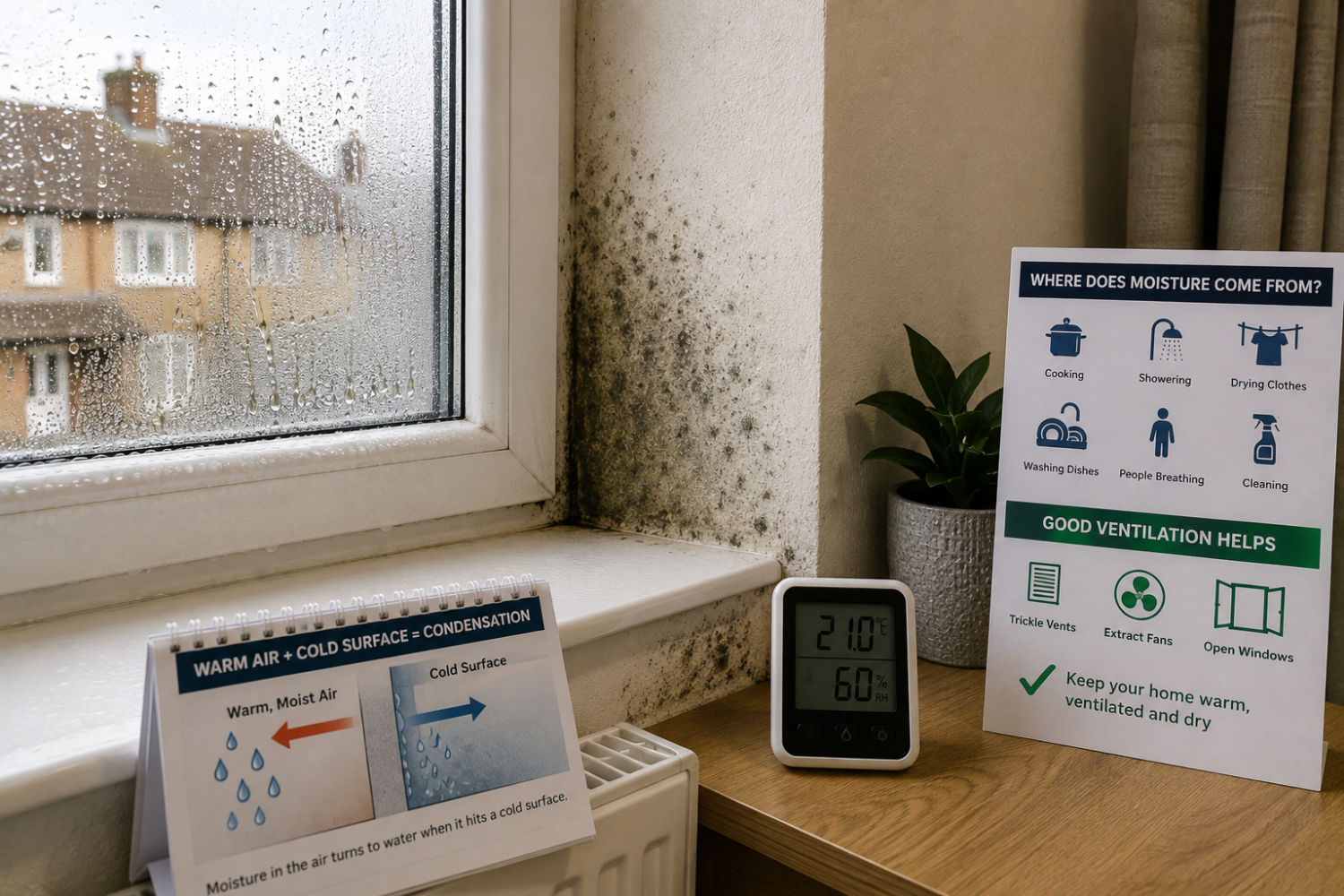
Condensation can sometimes become more noticeable after fitting new windows, adding insulation or making a home more airtight. This does not necessarily mean the energy-efficiency work was a mistake. It can happen because the property now loses less uncontrolled air, while moisture produced inside the home still needs an effective way to escape.
For homeowners, landlords and property managers across Horley, Reigate, Redhill, Crawley, Surrey and West Sussex, understanding the relationship between insulation, airtightness, heating and ventilation can help prevent condensation becoming a recurring problem. This guide explains:
- Why condensation forms
- Why new windows can change ventilation
- Whether insulation causes condensation
- Why airtightness and ventilation are different
- Where moisture inside a home comes from
- Why cold surfaces matter
- How thermal bridging can contribute
- Why trickle vents and extract ventilation matter
- How Building Regulations treat ventilation
- When a building assessment is worthwhile
Why does condensation form inside a home?
Condensation forms when moisture in the indoor air reaches a surface that is cold enough for some of that water vapour to turn into liquid water.
You commonly see this on windows because glass can be one of the colder surfaces in a room during winter.
However, condensation can also develop on walls, ceilings, window reveals and external corners.
Whether it occurs depends on a combination of indoor humidity, surface temperature, heating, ventilation and the construction of the property.
This is why two apparently similar homes can experience very different condensation problems.
Where does all the moisture inside a house come from?
Normal everyday activities continuously add moisture to the indoor air.
Common sources include:
- showering and bathing
- cooking
- drying clothes indoors
- washing dishes
- cleaning
- people breathing
None of these activities is unusual. The building simply needs an appropriate way of managing the moisture they create.
If moisture production is high and ventilation is inadequate, indoor humidity can rise.
When that humid air reaches colder surfaces, condensation becomes more likely.
Why can condensation appear after replacing old windows?
Older windows can allow uncontrolled air to pass through gaps around frames, seals and opening sections.
Although this air leakage can make a property draughty and increase heat loss, it may also have been providing some unintended ventilation.
Modern replacement windows are generally much better sealed.
Once the old leakage paths are removed, the property may retain heat more effectively but it may also retain more moisture if suitable ventilation has not been maintained.
The problem is therefore not simply that the new windows are “too good”. It is that the ventilation strategy of the whole property may have changed.
Does insulation cause condensation?
Correctly designed insulation does not simply “cause condensation”. In fact, insulation can raise internal surface temperatures and reduce the likelihood of condensation forming on some surfaces.
However, energy-efficiency work can change how heat, air and moisture move through a building.
If insulation work is combined with sealing gaps and reducing uncontrolled air leakage, the home may become more airtight.
That is normally desirable for energy efficiency, but appropriate ventilation becomes increasingly important.
Problems can also occur where insulation is incomplete, badly detailed or unsuitable for the existing construction.
What is the difference between airtightness and ventilation?
Airtightness and ventilation are related, but they are not the same thing.
Airtightness is about limiting uncontrolled air leakage through gaps and cracks in the building fabric.
Ventilation is the deliberate replacement of stale indoor air with fresh outside air.
A well-designed building can therefore be relatively airtight while still being properly ventilated.
The aim is not to rely on random gaps around windows, floors and pipework to provide fresh air. Instead, air should enter and leave through an appropriate ventilation strategy.
This distinction is important when improving older homes.
Why shouldn’t you just leave the house draughty?
Uncontrolled draughts are not an efficient ventilation strategy.
Air may enter in the wrong places, at the wrong rate and at times when it is not needed.
This can make rooms uncomfortable and increase heating demand without necessarily removing moisture effectively from areas such as kitchens and bathrooms.
A more controlled approach is generally preferable.
That means reducing unwanted leakage while ensuring the property still has suitable background and extract ventilation for its design and use.
Why do cold surfaces make condensation worse?
The colder a surface becomes, the easier it can be for moisture in the surrounding air to condense on it.
This is why condensation frequently appears around windows, external corners and other relatively cold parts of a room.
Improving insulation can help increase some internal surface temperatures, but the result depends on how continuous the insulation is.
If one small area remains significantly colder than everything around it, condensation may become concentrated there instead.
This is one reason building-fabric details matter rather than simply looking at the total thickness of insulation.
Can thermal bridging cause condensation?
Thermal bridging can contribute to condensation by creating locally colder internal surfaces.
A thermal bridge is an area where heat passes through the building construction more readily than through the surrounding fabric.
Common locations can include:
- external corners
- window reveals
- lintels
- wall-to-floor junctions
- wall-to-roof junctions
- structural elements
If indoor humidity is high and one of these surfaces becomes sufficiently cold, condensation may occur there even when the rest of the room appears dry.
Repeated mould in exactly the same corner can therefore justify further investigation rather than simply repeated cleaning.
Why can mould appear after energy-efficiency work?
Mould needs suitable environmental conditions to grow, including moisture.
If an energy upgrade reduces uncontrolled ventilation without providing or maintaining sufficient controlled ventilation, moisture may remain inside for longer.
Combine that with a cold surface and conditions may become favourable for mould growth.
However, mould after an energy upgrade does not automatically prove that ventilation is the only problem.
Water leaks, penetrating damp, thermal bridging, insulation defects and other building issues can create similar symptoms.
The cause should be established before expensive remedial work is undertaken.
What are trickle vents for?
Trickle vents, also known as background ventilators, provide a controlled route for outside air to enter a room without needing the main window to be fully opened.
They form part of the ventilation strategy in many homes.
Current Building Regulations guidance in England includes specific provisions for ventilation when windows are replaced because changing from leaky older windows to more airtight replacements can reduce existing ventilation.
Whether additional background ventilation is required depends on the existing property and the work being carried out.
The correct approach should therefore be assessed rather than simply blocking vents because they feel cold during winter.
Should trickle vents be left open?
Where trickle vents form part of the intended ventilation system, they generally need to remain open and unobstructed for that system to work as designed.
Closing every vent to make the property feel warmer can reduce the amount of fresh air entering the home.
That may appear to improve comfort temporarily but can increase moisture and indoor-air-quality problems.
If the property feels excessively draughty despite using the ventilation system correctly, the cause should be investigated rather than permanently disabling ventilation.
Why are bathroom and kitchen extract fans important?
Kitchens and bathrooms can generate large amounts of moisture over relatively short periods.
Extract ventilation helps remove that moisture close to where it is produced.
If an extract fan is not working properly, has a blocked duct, is switched off or is significantly underperforming, moisture can spread into the rest of the property.
This can become particularly noticeable after other uncontrolled air-leakage routes have been reduced.
Checking that extract ventilation is present, functioning and being used correctly is therefore an important part of investigating condensation.
Do Building Regulations cover ventilation when improving an existing home?
Yes. In England, ventilation is addressed by Part F of the Building Regulations, with Approved Document F providing guidance on how the requirements can be met.
When certain energy-efficiency measures or replacement windows are installed in an existing dwelling, the effect on ventilation needs to be considered.
The principle is important: improving energy efficiency should not leave the dwelling with inadequate ventilation.
The exact requirements depend on the work, the existing ventilation and which regulatory provisions apply to the project.
This is different from simply saying that every renovation requires the same number or type of vents.
Should I open the windows every day?
Opening windows can provide additional ventilation and can be useful for quickly removing moisture, but it should not necessarily be the only ventilation strategy in a home.
People cannot realistically be expected to leave large windows open continuously throughout winter, overnight or while the property is unoccupied.
Background and extract ventilation are intended to provide more reliable ventilation as part of normal building operation.
How the property should be ventilated depends on its existing systems and construction.
Can a dehumidifier solve the problem?
A dehumidifier can reduce moisture levels in indoor air and may be useful in certain circumstances, but it does not automatically fix the underlying cause of condensation.
If the real problem is inadequate ventilation, a building defect, water ingress or an unusually cold surface, removing moisture with a portable appliance may only manage the symptom.
That does not make dehumidifiers useless. It simply means they should not replace proper investigation where condensation is persistent or severe.
How do you work out what is actually causing the condensation?
The first step is to look at the pattern rather than assuming every condensation problem has the same cause.
A building assessment may consider:
- where condensation appears
- when it occurs
- indoor humidity
- ventilation provision
- extract fans
- window replacement history
- recent insulation work
- heating patterns
- wall and roof construction
- possible thermal bridges
- possible damp or water ingress
Thermal imaging can sometimes provide additional information by identifying unusual surface-temperature patterns, although it does not directly prove the cause of moisture.
What should I check after having new windows fitted?
If condensation becomes noticeably worse following window replacement, it is worth reviewing how ventilation was dealt with as part of the installation.
Check whether background ventilators are present where required and whether existing ventilation has been blocked or removed.
You should also check that bathroom and kitchen extraction is functioning correctly.
If the problem persists despite appropriate use of the ventilation system, a wider building assessment may be worthwhile.
For example, condensation concentrated around one window reveal may have a different cause from condensation occurring across every window in the property.
What should I consider before insulating an older home?
Older buildings should be considered carefully before substantial changes are made to their fabric.
Different wall and floor constructions can behave differently in relation to heat and moisture.
A solid-wall property in Reigate, for example, may need a different approach from a more recent cavity-wall home in Crawley.
Insulation, ventilation, moisture management, heating and existing building condition should therefore be considered together.
The aim is to improve energy performance without creating unintended consequences elsewhere in the property.
When should I get the property professionally assessed?
An assessment is particularly worthwhile when condensation or mould is persistent, severe or has appeared following substantial changes to the building.
You should also consider further investigation if:
- mould repeatedly returns after cleaning
- only one wall or corner is affected
- the problem appeared after insulation work
- the problem appeared after window replacement
- you suspect ventilation is inadequate
- there are signs of a building defect
- you are planning further energy-efficiency work
Understanding the cause first can prevent money being spent on improvements that do not address the actual problem.
JPEC Building Services can help
JPEC Building Services can help homeowners, landlords, developers and property professionals understand condensation, ventilation and building-fabric performance across Horley, Reigate, Redhill, Crawley, Surrey and West Sussex.
We can assess the property, review its construction and recent energy-efficiency improvements and help identify whether further investigation into ventilation, insulation, thermal bridging, heat loss or another building issue is appropriate.
Our wider services include heat-loss assessments, thermal-performance advice, SAP calculations, EPC work, overheating assessments and other building-performance and compliance support.
Rather than treating condensation as an isolated problem, we can consider how the building fabric, heating, ventilation and intended improvements interact.
As part of the wider JPEC Group, findings can also be coordinated with relevant building, electrical and green-energy works where appropriate.
To discuss your property or planned energy-efficiency improvements, contact JPEC Building Services.
This article provides general information and is not property-specific building, damp, ventilation or energy advice. Condensation and mould can have several possible causes. Recommendations should be confirmed through an appropriate survey or assessment of the individual property before remedial work is undertaken.