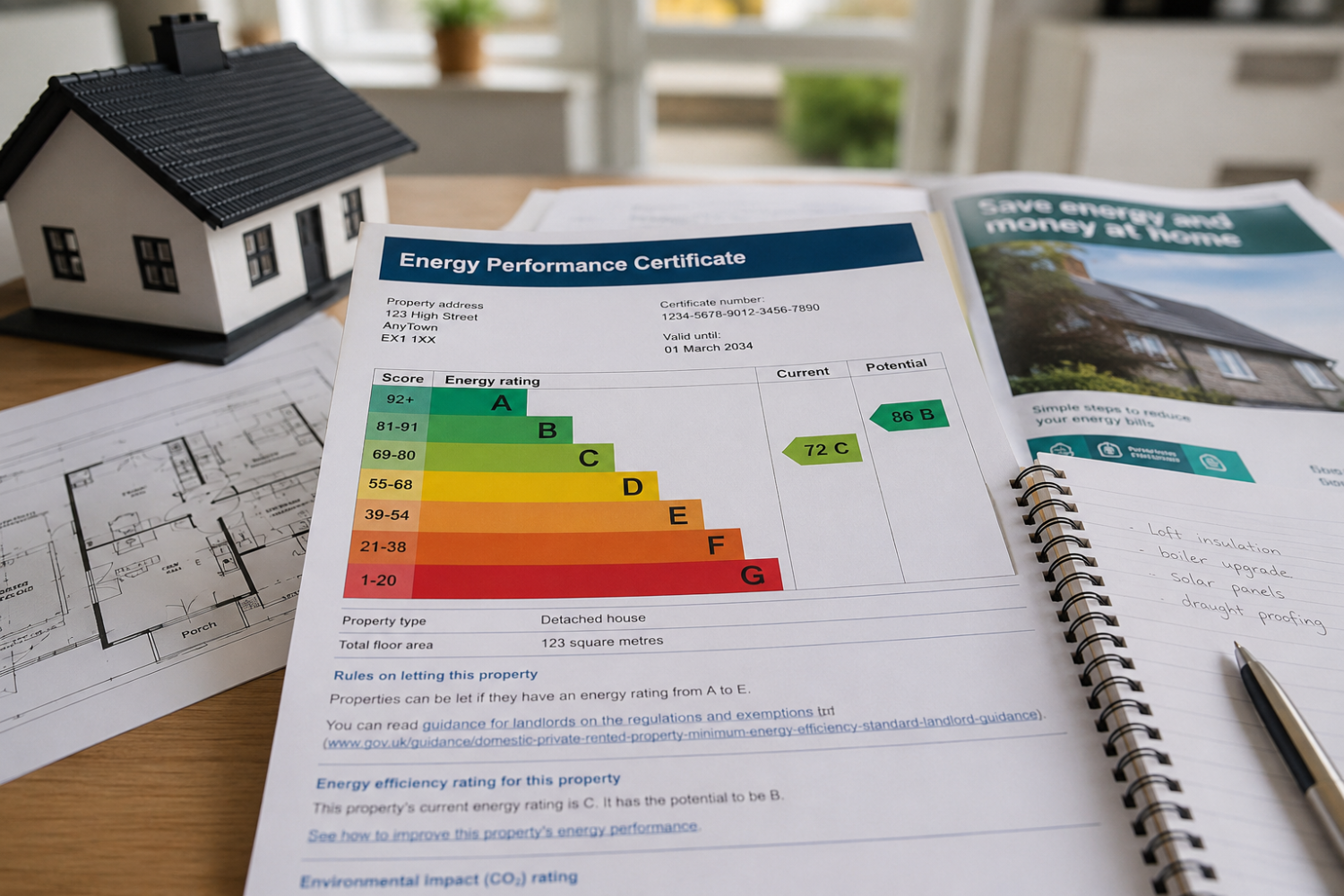
Yes, you usually need an EPC if you are selling, renting, or building a home or commercial property in the UK. An EPC, which stands for Energy Performance Certificate, rates how energy efficient a property is and gives recommendations for improvement. For homeowners, landlords, and business owners in areas such as Horley, Reigate, Redhill, Crawley, Surrey, and West Sussex, it is often a key part of property compliance.
This guide explains when an EPC is needed, what it tells you, what happens during an assessment, and what you should do if your rating is lower than expected.
We’ll cover:
- What an EPC is
- When you need one
- EPCs for homes
- EPCs for rental properties
- EPCs for commercial buildings
- What an EPC assessment involves
- What affects your EPC rating
- How long an EPC lasts
- What can go wrong
- How JPEC Building Services can help
What is an EPC?
An EPC is a certificate that shows how energy efficient a building is. It gives the property a rating from A to G, with A being the most efficient and G being the least efficient.
The certificate also includes recommendations for improving the property’s energy performance. These might include insulation, heating upgrades, lighting improvements, solar panels, better controls, or other changes depending on the building.
For many people, an EPC is treated as paperwork needed for a sale or rental. In reality, it can also help you understand running costs, comfort, heat loss, and future improvement options.
You can check whether a property already has an EPC using the government’s energy certificate register. (gov.uk)
When do you need an EPC?
You usually need an EPC when a property is built, sold, or rented. This applies to many homes and business premises in England and Wales.
For domestic properties, an EPC is normally needed when you market a home for sale or rent. For commercial properties, an EPC is also generally required when a building is sold, rented, or constructed. Government guidance confirms that business premises may need an EPC when they are sold, rented, or built. (gov.uk)
In simple terms, you should expect to need an EPC if you are:
- selling a house or flat
- letting a rental property
- building a new property
- selling or letting a shop, office, unit, workshop, or other commercial building
- making certain changes where updated energy information is required
There are exemptions in some cases, but you should not assume your property is exempt without checking properly.
Do I need an EPC for my home?
If you are selling your home, you normally need an EPC before or when the property is marketed. This helps buyers understand the likely energy performance of the property before they commit. Government guidance for selling a home includes EPCs as part of the sale process. (gov.uk)
If you are not selling or renting your home, you may not legally need a new EPC. However, you might still choose to get one if you want to understand your property’s efficiency, plan improvements, or prepare for future works.
For example, an older home in Reigate or Redhill may have solid walls, older glazing, limited loft insulation, or an ageing heating system. An EPC can help highlight likely areas for improvement, although it should not replace a detailed survey or heat loss assessment.
JPEC Building Services can support homeowners by explaining what the EPC result means in plain English and what practical steps may be worth considering.
Do landlords need an EPC for rental properties?
Yes, landlords normally need a valid EPC when letting a domestic rental property. The EPC rating is also important because minimum energy efficiency rules can affect whether a property can legally be let.
In England and Wales, private rented properties are subject to Minimum Energy Efficiency Standards, often called MEES. MEES means landlords must meet a minimum energy performance level unless a valid exemption applies. Government guidance on PRS exemptions confirms that exemptions require supporting information and a valid EPC for the property. (gov.uk)
For landlords in Horley, Crawley, Surrey, or West Sussex, this matters because a poor EPC rating can affect lettability, upgrade planning, and compliance risk.
A landlord EPC should be treated as more than a tick-box document. It can help you understand whether improvements such as insulation, heating controls, low-energy lighting, or renewable technology suitability may need to be reviewed.
Do I need an EPC for a commercial building?
Yes, many commercial buildings need an EPC when they are sold, rented, or newly built. This can include offices, shops, warehouses, industrial units, workshops, showrooms, hospitality premises, and some agricultural or rural business buildings.
Commercial EPCs are different from domestic EPCs because the assessment looks at non-domestic building features. This can include heating, cooling, ventilation, lighting, building fabric, controls, and how the space is used.
A small office in Redhill, a warehouse near Crawley, or a rural commercial unit in West Sussex may all have very different energy profiles. That is why commercial EPC work needs to be assessed properly rather than guessed.
Government guidance says EPCs for business properties can involve requirements around applying for certificates, displaying certificates in certain cases, and penalties where rules are not followed. (gov.uk)
Are agricultural buildings treated differently?
Some agricultural buildings may need an EPC, while others may not. It depends on the type of building, how it is used, whether it is heated or cooled, and whether it is being sold, rented, or constructed.
A basic unheated storage barn may be treated differently from a heated farm office, dairy processing space, rural workshop, farm shop, or commercial unit on an agricultural estate.
This is where proper advice matters. Rural and agricultural properties often have mixed uses, older structures, large roof areas, variable occupancy, and unusual heating arrangements. JPEC Building Services can help assess what applies and whether an EPC, roof survey, heat loss survey, decarbonisation report, or wider energy performance review is more appropriate.
What does an EPC assessment involve?
An EPC assessment involves a qualified assessor inspecting the property and recording information about how it is built and how it uses energy.
For a domestic EPC, the assessor may look at things such as the property type, age, walls, roof, windows, heating system, controls, hot water, lighting, and insulation.
For a commercial EPC, the assessment can be more involved. The assessor may need information about floor areas, building layout, heating and cooling systems, ventilation, lighting, controls, and building use.
You may be asked for information such as:
- property plans, if available
- boiler or heating system details
- insulation evidence
- lighting details
- previous EPCs
- building age and construction details
- information about extensions or upgrades
The assessment is usually non-invasive. That means the assessor normally records visible information and available evidence rather than opening up walls or ceilings.
What affects your EPC rating?
Your EPC rating is affected by how much energy the building is expected to use and how efficiently it uses it. The result is based on standard assumptions, so it may not exactly match your actual bills.
Common factors include insulation levels, heating efficiency, hot water systems, windows, lighting, controls, ventilation, and renewable technologies.
In homes across Surrey and West Sussex, older building fabric can have a major impact. In commercial buildings, heating, cooling, ventilation, and lighting can make a significant difference.
This is why two buildings that look similar from the outside can receive different ratings. One may have better insulation, newer heating controls, or more efficient lighting. Another may lose heat quickly or rely on older systems.
JPEC Building Services can help explain what is likely driving the rating and whether further assessment, such as a heat loss survey or condition report, would be useful.
How long does an EPC last?
An EPC is usually valid for 10 years, unless a new one is produced sooner. If you make significant changes to the property, such as heating upgrades, insulation improvements, extensions, or renewable energy additions, it may be worth getting an updated EPC.
A valid EPC does not always mean the information is still useful. For example, a certificate from several years ago may not reflect recent upgrades, changes in building use, or current improvement plans.
If you are selling, letting, refinancing, planning upgrades, or reviewing compliance, it is sensible to check whether the existing EPC still reflects the property accurately.
What can go wrong with EPCs?
The most common issue is assuming an EPC tells the whole story. It is a useful compliance and comparison tool, but it is not the same as a full building survey, heat loss calculation, retrofit plan, or decarbonisation strategy.
Problems can happen when:
- the assessor does not have enough evidence
- insulation or upgrades cannot be verified
- the property has unusual construction
- the building has mixed domestic and commercial use
- recommendations are treated as automatic instructions
- landlords leave improvements too late
- businesses do not plan around future energy performance expectations
Some EPC recommendations may be sensible, while others may need more investigation before you spend money. For example, a recommendation might suggest solar panels, but a proper roof survey should confirm roof condition, orientation, shading, structure, and electrical suitability before any decision is made.
Can an EPC help you plan improvements?
Yes, an EPC can be a useful starting point for planning improvements, but it should not be the only assessment you rely on.
For a homeowner, it may highlight insulation, heating, or lighting upgrades. For a landlord, it may help prioritise works before letting a property. For a commercial or agricultural site, it may support wider planning around energy costs, decarbonisation, solar suitability, or building condition.
JPEC Building Services can connect EPC advice with wider building performance support, including energy efficiency advice, roof surveys for solar suitability, heat loss surveys, condition reports, sustainability reports, and decarbonisation reports where relevant.
This joined-up approach can help you avoid spending money on isolated upgrades that do not properly suit the building.
What should you do before booking an EPC?
Before booking an EPC, gather any useful information about the property. This can help the assessor record the building more accurately.
Useful evidence may include insulation certificates, boiler details, window installation information, building plans, completion certificates, or details of previous upgrades.
If you own a commercial or rural building, it is also worth checking how the property is used, which areas are heated or cooled, and whether there are separate units or mixed uses.
For properties around Horley, Reigate, Redhill, Crawley, Surrey, and West Sussex, JPEC Building Services can advise whether a standard EPC is enough or whether you may benefit from a wider assessment.
JPEC Building Services can help
JPEC Building Services are experienced local building compliance, energy performance, surveying, and sustainability specialists supporting homeowners, landlords, developers, commercial clients, and rural businesses across Horley, Reigate, Redhill, Crawley, Surrey, West Sussex, and surrounding areas.
They can help assess, survey, calculate, report, advise, and support you properly, whether you need an EPC, condition report, heat loss survey, roof survey, sustainability report, decarbonisation report, SAP calculation, Predicted Energy Assessment, or wider compliance support.
As part of the wider JPEC Group, JPEC Building Services can also help connect assessment, compliance, design, and delivery where appropriate. The aim is to explain trade-offs, compliance requirements, likely performance, and practical next steps in plain English.
This article is general information only and is not personal advice. Recommendations should always be confirmed through a proper survey, inspection, assessment, calculation, or system design for the individual property and requirements.