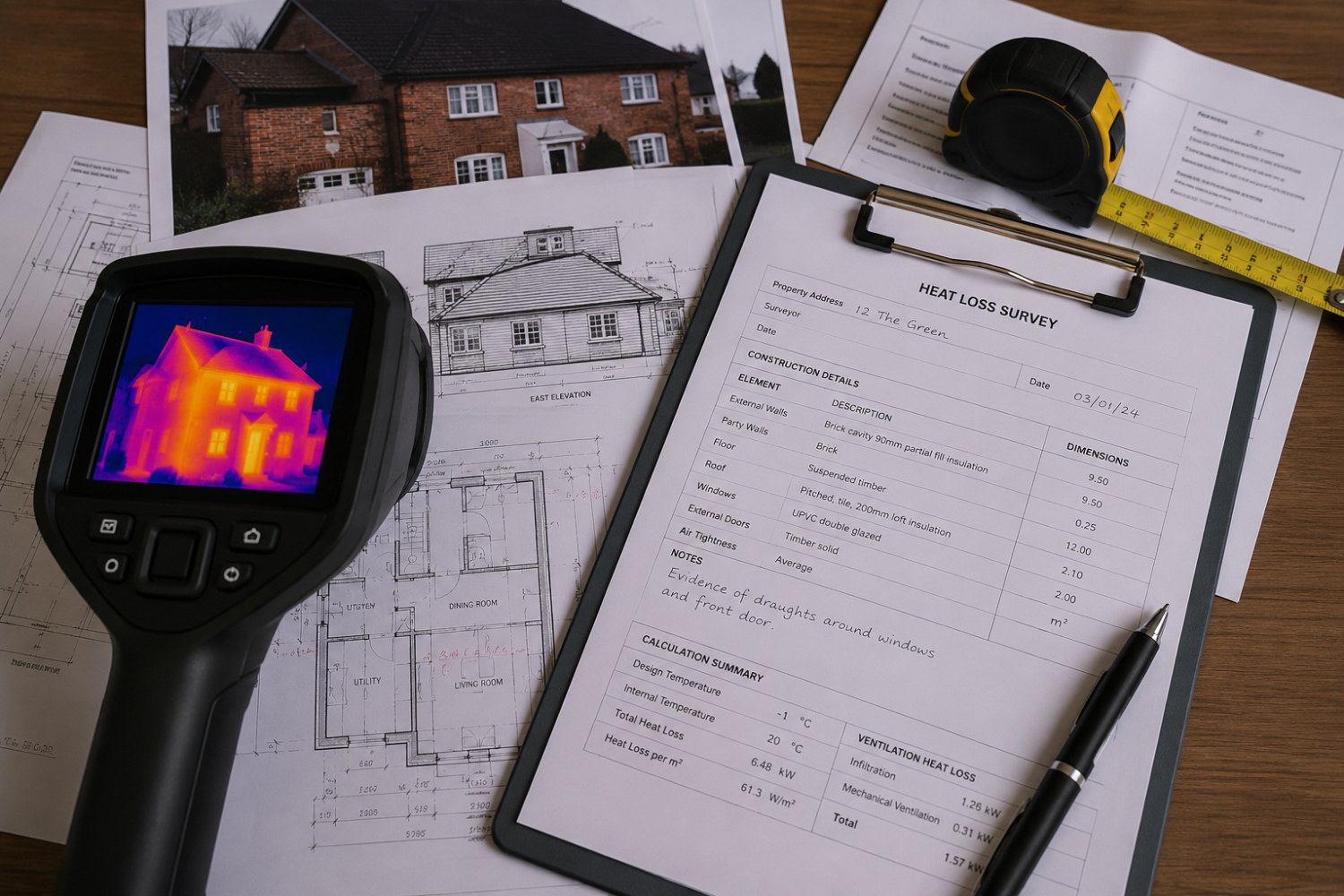
A heat loss survey shows where and how your home loses heat, helping you understand what improvements may make the biggest difference to comfort, energy use, and running costs. For homes across Horley, Reigate, Redhill, Crawley, Surrey, and West Sussex, it can be especially useful before insulation upgrades, heating changes, or renewable energy improvements.
This guide explains what a heat loss survey is, when you may need one, what happens during the assessment, and how the results can help you make better decisions.
We’ll cover:
- What a heat loss survey is
- Why heat loss matters
- When you might need one
- What the survey involves
- What affects heat loss in a home
- How heat loss surveys support heating upgrades
- How they relate to EPCs and energy performance
- Common problems a survey may identify
- What to do after a heat loss survey
- How JPEC Building Services can help
What is a heat loss survey?
A heat loss survey is an assessment of how much heat your home loses through walls, floors, roofs, windows, doors, draughts, and ventilation. It helps identify where warmth is escaping and what areas may need attention.
In simple terms, it shows how hard your heating system has to work to keep your home comfortable.
A heat loss survey may include a visual inspection, property measurements, construction details, insulation checks, heating information, and sometimes thermal imaging. Thermal imaging uses a specialist camera to show temperature differences, which can help highlight cold spots, draughts, missing insulation, or areas where heat may be escaping.
A proper heat loss survey is not just about finding cold rooms. It helps build a clearer picture of the building’s performance.
Why does heat loss matter?
Heat loss matters because it affects comfort, running costs, heating design, and energy performance. If your home loses heat quickly, you may spend more money trying to keep it warm.
A home with high heat loss can feel cold even when the heating is on. You may notice rooms cooling down quickly, draughts around windows or doors, cold floors, condensation, or uneven temperatures between rooms.
For older homes in Reigate, Redhill, and surrounding parts of Surrey, heat loss can be affected by solid walls, older glazing, limited insulation, draughty openings, or ageing heating systems. In rural or semi-rural properties in West Sussex, larger rooms, exposed positions, and older construction can also play a part.
Understanding heat loss helps you avoid guessing. Instead of spending money on random upgrades, you can focus on improvements that are more likely to suit the property.
When do you need a heat loss survey?
You may need a heat loss survey if your home is cold, expensive to heat, difficult to balance, or being considered for heating or insulation upgrades. It is especially useful before major decisions are made.
A heat loss survey can help if:
- your rooms heat unevenly
- your energy bills seem high
- your home loses warmth quickly
- you are planning insulation upgrades
- you are considering a heat pump
- you are replacing radiators or heating controls
- you are improving an older property
- you want to understand comfort issues before spending money
For homeowners in Horley, Crawley, Surrey, and West Sussex, a heat loss survey can be a practical first step before deciding whether to upgrade insulation, change the heating system, or explore renewable technologies.
JPEC Building Services can assess your property and explain the findings clearly, so you understand what the results mean in real-world terms.
What does a heat loss survey involve?
A heat loss survey usually involves inspecting the property, recording construction details, measuring rooms, and reviewing how the home is heated and insulated. The exact process depends on the property and the level of assessment required.
The assessor may look at walls, floors, roofs, loft insulation, windows, doors, heating systems, radiators, ventilation, draughts, and any obvious cold areas.
They may also ask about how the home feels in normal use. For example, whether certain rooms are always colder, whether condensation appears on windows, or whether the heating has to stay on for long periods.
A heat loss calculation may also be carried out. A heat loss calculation estimates how much heat each room or the whole property loses, usually measured in watts. In plain English, it helps show how much heating power is needed to keep the space warm.
What information will you need to provide?
You do not always need detailed paperwork, but any useful information about your home can help improve the accuracy of the assessment. The more evidence available, the easier it is to understand the building properly.
Helpful information may include:
- the age of the property
- details of extensions or conversions
- insulation certificates or installation details
- window and door specifications
- boiler, heat pump, or heating system information
- floor plans, if available
- previous EPCs or energy reports
- details of problem rooms or comfort issues
If you do not have this information, the survey can still usually go ahead. The assessor may simply need to make reasonable observations based on what can be seen and measured.
JPEC Building Services can help you understand what information is useful before the survey and what can be checked on site.
What affects heat loss in a home?
Heat loss is affected by how the home is built, insulated, ventilated, heated, and used. Two homes on the same street can perform very differently.
Important factors include the type of walls, roof insulation, floor construction, window quality, draughts, property size, room layout, heating controls, and exposure to wind or shade.
A newer home near Crawley or Horley may have better insulation and airtightness than an older solid-wall property in Redhill or Reigate. However, even newer homes can have comfort problems if heating controls are poor, insulation is incomplete, or ventilation is not working as intended.
Heat loss is not always caused by one big issue. It is often the result of several smaller weaknesses adding up.
Can a heat loss survey help before installing a heat pump?
Yes, a heat loss survey is very useful before installing a heat pump because heat pumps need to be sized and designed carefully. If the heat loss is not properly understood, the system may be too small, too large, inefficient, or unsuitable without other improvements.
A heat pump works best in a property that can hold heat reasonably well. This does not mean every home must be perfect, but it does mean the building should be assessed properly before decisions are made.
A heat loss survey can help identify whether you may need larger radiators, better insulation, improved controls, or other changes before a heat pump is considered.
JPEC Building Services work as part of the wider JPEC Group, helping connect assessment, compliance, design, and delivery where appropriate. This can help you avoid treating the heat pump as a standalone product when the whole building needs to be considered.
How does a heat loss survey relate to an EPC?
A heat loss survey and an EPC are connected, but they are not the same thing. An EPC, or Energy Performance Certificate, gives your property an energy rating, while a heat loss survey looks more closely at how heat escapes from the building.
An EPC is useful for understanding overall energy performance and compliance, especially when selling or renting a property. A heat loss survey is usually more practical when you are trying to solve comfort problems, plan heating upgrades, or understand where improvements may be needed.
For example, an EPC may recommend insulation, but a heat loss survey can help you understand where heat is actually being lost and how that may affect comfort or heating design.
JPEC Building Services can support EPC surveys, heat loss surveys, building energy efficiency advice, and wider property performance improvements, helping you choose the right assessment for your situation.
What common problems can a heat loss survey identify?
A heat loss survey can help identify issues that are easy to miss during everyday use. Some problems are obvious, such as draughty windows. Others may only become clear when the property is assessed as a whole.
Common findings can include:
- missing or thin loft insulation
- poorly insulated walls or floors
- draughts around doors, windows, loft hatches, or floorboards
- cold bridges around structural details
- underperforming radiators
- heating controls that are not set up well
- rooms that need different heating design
- ventilation or condensation concerns
A cold bridge is an area where heat passes through more easily, often around corners, lintels, floors, or junctions in the building. In simple terms, it is a weak point where heat can escape and cold can appear internally.
Not every issue requires major work. Sometimes small improvements can help. In other cases, a more planned approach may be needed.
Is a heat loss survey worth it?
A heat loss survey can be worth it if you are planning improvements, struggling with comfort, or unsure where to spend money first. It helps reduce guesswork.
Without a proper assessment, it is easy to spend money on upgrades that do not solve the main problem. For example, replacing a heating system may not fix cold rooms if the real issue is missing insulation or draughts. Likewise, adding insulation without considering ventilation can create other problems if it is not done properly.
A heat loss survey does not guarantee savings or a specific result. What it can do is help you understand the property better and make more informed decisions.
For landlords, homeowners, and property owners in Surrey and West Sussex, this can be especially useful when balancing cost, comfort, compliance, and long-term energy performance.
What happens after a heat loss survey?
After a heat loss survey, you should receive findings or recommendations that explain the main areas of concern and possible next steps. The level of detail depends on the type of survey and what you need it for.
The results may help you decide whether to improve insulation, upgrade heating controls, resize radiators, investigate draughts, consider renewable technologies, or commission further assessment.
In some cases, the next step may be a more detailed design. For example, if you are considering a heat pump, the survey findings may support a proper system design. If you are reviewing a rental property, the results may sit alongside EPC advice. If you own a rural or commercial property, the findings may form part of a wider sustainability or decarbonisation review.
JPEC Building Services can explain the trade-offs, likely performance, and practical next steps in plain English.
What should you be careful about?
The main thing to be careful about is treating a heat loss survey as a magic answer on its own. It is a useful assessment, but recommendations still need to be considered in the context of the property, budget, building condition, and future plans.
You should be cautious about one-size-fits-all advice. A Victorian terrace, a modern detached home, a converted barn, and a rural property in West Sussex may all need different solutions.
You should also be careful about making changes without considering ventilation, damp, condensation, and building fabric. Improving energy efficiency is important, but it needs to be done properly.
This is why a professional survey, inspection, assessment, or system design is important before committing to major works.
JPEC Building Services can help
JPEC Building Services are experienced local building compliance, energy performance, surveying, and sustainability specialists supporting homeowners, landlords, developers, commercial clients, and business owners across Horley, Reigate, Redhill, Crawley, Surrey, West Sussex, and surrounding areas.
They can help assess, survey, calculate, report, advise, and support you properly, whether you need a heat loss survey, EPC survey, condition report, roof survey for solar suitability, sustainability report, decarbonisation report, SAP calculation, Predicted Energy Assessment, or wider compliance support.
As part of the wider JPEC Group, JPEC Building Services can help connect assessment, compliance, design, and delivery where appropriate. The aim is to explain trade-offs, comfort issues, energy performance, likely improvements, and practical next steps in plain English.
This article is general information only and is not personal advice. Recommendations should always be confirmed through a proper survey, inspection, assessment, calculation, or system design for the individual property and requirements.