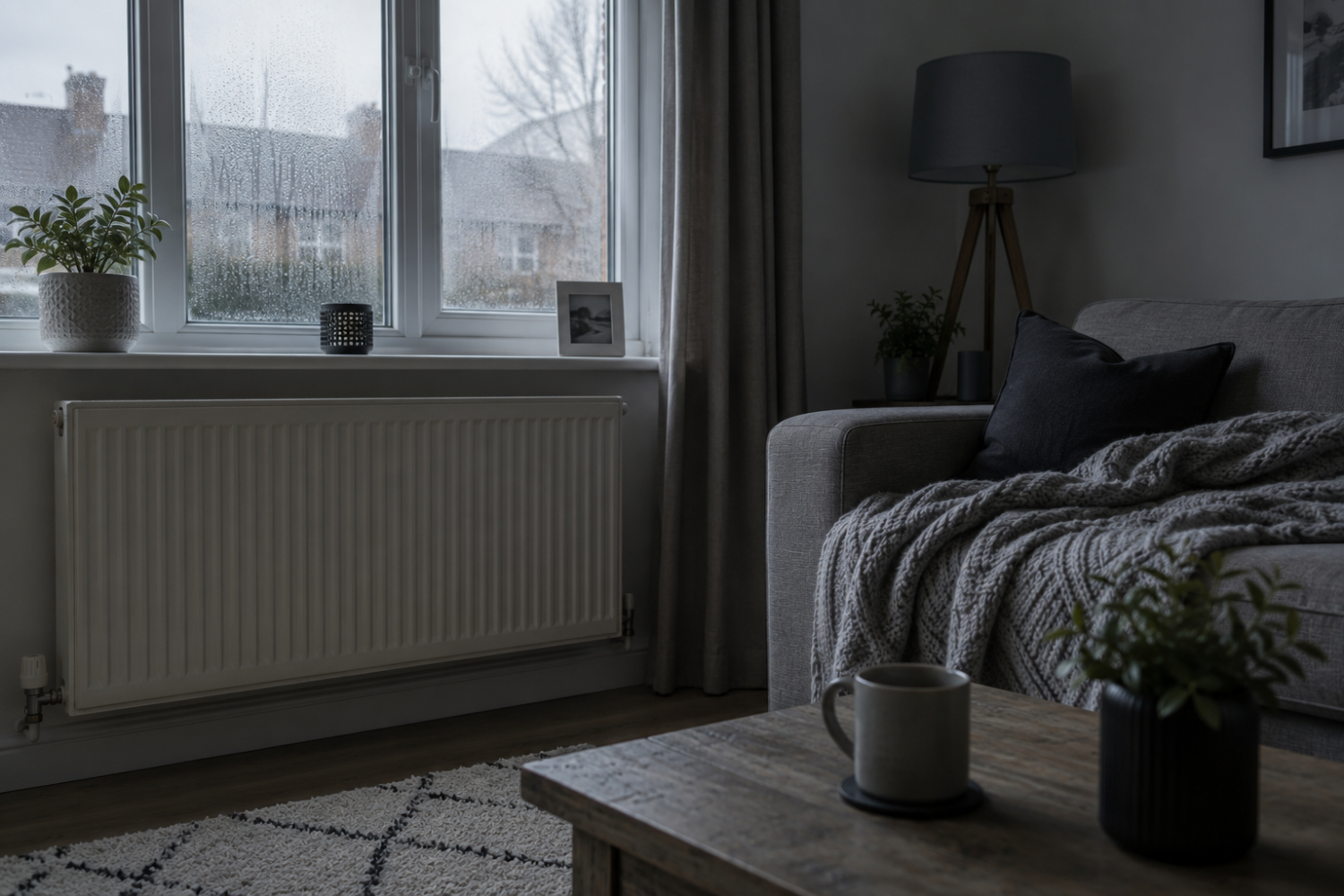
If your heating is running but your home still feels cold, there may be an underlying problem with the building, the radiators or the heating system itself.
This is a common issue in homes across Horley, Reigate, Redhill, Crawley, Surrey, West Sussex, East Sussex and Kent, particularly in older properties, extended homes and buildings with insufficient insulation.
Cold rooms, draughts, uneven temperatures and rising energy bills can all indicate that heat is escaping faster than the heating system can replace it.
JPEC Building Services provides professional heat loss surveys in Surrey, Sussex, Kent and the wider South East, helping homeowners, landlords, developers and commercial property owners understand why their buildings are difficult to heat.
In this guide, we explain why your house may remain cold even when the heating is on and how a professional heat loss assessment can help identify the cause.
Why does my house still feel cold when the heating is on?
Your heating system creates warmth, but your property must also be able to retain and distribute that warmth effectively.
When a home loses heat through its walls, roof, floors, windows, doors and ventilation openings faster than the heating system can replace it, rooms may struggle to reach a comfortable temperature.
This can happen even when:
- The boiler is running
- The radiators feel hot
- The thermostat is turned up
- The heating has been operating for several hours
- Energy bills are increasing
Many homes across Surrey and Sussex include older building materials, solid walls, suspended timber floors, loft conversions and later extensions. These features can create very different heat-loss levels from one room to another.
The problem may be caused by one issue or a combination of:
- Poor insulation
- Draughts and uncontrolled air leakage
- Older windows or external doors
- Undersized radiators
- An incorrectly sized heating system
- Poor heating controls
- An unbalanced heating system
- Damp or cold external walls
- High ceilings and open-plan spaces
- Heat escaping through roofs, walls and floors
Simply turning the thermostat higher may increase energy consumption without resolving the underlying issue.
Heat may be escaping through your loft or roof
Warm air rises, making the roof and loft area one of the most important parts of a property’s thermal performance.
If loft insulation is missing, compressed, damaged or incorrectly fitted, a significant amount of heat may escape through the ceiling and roof.
This is particularly common in older homes around Horley, Reigate, Redhill, Crawley and surrounding Surrey and Sussex towns, where loft insulation may have been installed many years ago or disturbed during later electrical and building work.
Possible signs of excessive roof heat loss include:
- Upstairs bedrooms remaining cold
- The property cooling quickly after the heating turns off
- Cold ceilings
- Uneven loft insulation
- Draughts around the loft hatch
- High heating bills during winter
Loft conversions can also experience substantial heat loss when insulation around roof slopes, dormers, eaves and ceilings has not been installed correctly.
A professional heat loss survey in Surrey or Sussex can assess how much the roof contributes to the property’s overall heating requirement.
Your external walls may be losing too much heat
The amount of heat lost through a wall depends on its construction, thickness, insulation and exposure.
Older solid-wall properties generally lose more heat through their walls than modern insulated homes. Cavity-wall properties can also perform poorly when the cavity is uninsulated or the insulation is incomplete.
Across areas such as Reigate, Redhill, Dorking, Horsham, East Grinstead and Crawley, there is a wide range of property types, including:
- Victorian and Edwardian homes
- 1930s houses
- Post-war properties
- Modern new-build developments
- Converted commercial buildings
- Extended family homes
- Flats and maisonettes
Each property type can have a different level of heat loss.
Rooms with two or more external walls, such as corner bedrooms and end-of-terrace living rooms, often have a greater heating requirement than internal rooms.
This is why one room may remain noticeably colder than the rest of the home even when all radiators are switched on.
Draughts could be letting cold air into your home
Uncontrolled air leakage can make a room feel cold even when the heating system is producing enough heat.
Common draught sources include:
- Gaps around windows
- Poorly fitted external doors
- Letterboxes
- Loft hatches
- Suspended timber floors
- Unused fireplaces
- Pipe and cable penetrations
- Gaps around skirting boards
- Extractor fans
- Recessed lighting
- Poorly sealed extensions
Draughts are particularly common in older properties throughout Surrey, West Sussex and Kent.
However, ventilation is still essential for controlling condensation, moisture and indoor air quality. Air vents and ventilation systems should not simply be blocked without understanding their purpose.
The aim should be to reduce unwanted draughts while maintaining safe and suitable ventilation.
Your windows and doors may be causing heat loss
Older single-glazed windows normally lose more heat than modern double- or triple-glazed windows.
However, double glazing does not always mean that a window is performing effectively.
Heat loss and draughts can still occur when:
- Seals have failed
- Frames are damaged
- The glazing has been installed poorly
- Gaps exist around the frame
- External doors do not close correctly
- Large glazed areas create cold surfaces
Homes with patio doors, conservatories and large windows can experience increased heat loss, particularly during colder weather.
Properties around Horley, Gatwick, Crawley, Reigate and Redhill often include extensions and open-plan areas with large sections of glazing. These rooms can require more heating than the original radiators were designed to provide.
Curtains and blinds may reduce discomfort, but they will not correct failed seals, damaged frames or unsuitable glazing.
Your radiators may be too small
A radiator must provide enough heat to replace the heat being lost from the room.
If a radiator is undersized, it may feel very hot but still be unable to raise the room to the required temperature.
This commonly happens when:
- A property has been extended
- Internal walls have been removed
- A room has been converted
- Larger windows have been installed
- Insulation levels have changed
- Old radiators have been retained
- A heating system operates at a lower flow temperature
A radiator that was suitable for the original room may no longer be adequate after an extension or open-plan renovation.
A room-by-room heat loss calculation determines the heating requirement for each individual space and allows the existing radiator output to be checked.
JPEC Building Services provides room-by-room heat-loss calculations for properties across Surrey, Sussex, Kent and the South East.
Your heating system may need balancing
An unbalanced heating system can result in some radiators heating quickly while others remain cold or lukewarm.
Rooms close to the boiler may receive too much flow, while radiators further away receive insufficient hot water.
Typical signs include:
- Downstairs radiators heating before upstairs radiators
- Some rooms becoming too warm
- Distant rooms remaining cold
- Radiators heating at different speeds
- Uneven temperatures throughout the property
- The thermostat switching the heating off before all rooms are comfortable
Heating-system balancing may help distribute warmth more evenly.
However, cold radiators can also be caused by trapped air, sludge, faulty valves, poor circulation or an unsuitable pump setting.
A proper assessment should identify the likely cause before changes are made.
Your boiler or heating system may be the wrong size
A boiler or heat pump that is too small may struggle to replace the heat being lost from the property during cold weather.
However, fitting the largest possible system is not the correct solution.
An oversized heating system can:
- Cycle on and off frequently
- Operate inefficiently
- Provide poor temperature control
- Increase installation costs
- Create unnecessary noise
- Reduce system performance
Heating-system sizing should be based on a calculated property heat loss rather than floor area alone.
This is especially important for homeowners planning a boiler replacement or heat pump installation in Surrey, Sussex or Kent.
A professional heat loss calculation considers:
- Wall construction
- Roof construction
- Floor construction
- Window and door sizes
- Insulation levels
- Room dimensions
- Ventilation rates
- External design temperatures
- Adjacent heated and unheated spaces
This produces a more accurate heating requirement for the property.
Your heating controls may be causing uneven temperatures
Incorrectly positioned or poorly configured heating controls can prevent a home from heating evenly.
Possible issues include:
- A thermostat positioned near a radiator
- A thermostat located in direct sunlight
- Incorrect heating schedules
- Faulty thermostatic radiator valves
- Heating periods that are too short
- Incorrect boiler flow temperatures
- Poorly configured weather compensation
- Separate heating zones operating incorrectly
For example, a thermostat located in a warm hallway may switch the heating off before colder bedrooms or living spaces have reached a comfortable temperature.
This is common in larger and extended homes around Crawley, Horsham, East Grinstead, Dorking and Leatherhead, where different parts of the property may have very different heating requirements.
Cold floors may be making the room uncomfortable
Ground floors can contribute significantly to heat loss.
Older homes with suspended timber floors may have:
- Little or no insulation
- Draughts between floorboards
- Air leakage around skirting boards
- Gaps around pipes
- Cold air entering from the void below
Solid floors can also feel cold when they have limited insulation.
Even when the air temperature is reasonable, a cold floor can make the entire room feel uncomfortable.
Floor insulation may help, but it must be designed carefully to avoid restricting ventilation or creating moisture problems.
A building assessment can help identify the floor construction and determine whether it is likely to be contributing to excessive heat loss.
Damp walls can make a property feel colder
Damp walls and high indoor moisture levels can make a home feel colder and more difficult to heat.
Possible causes include:
- Condensation
- Plumbing leaks
- Penetrating rain
- Damaged gutters
- Defective downpipes
- Failed window seals
- Inadequate ventilation
- Drainage problems
- Water entering around roofs or walls
Properties in exposed areas of Surrey, Sussex and Kent may be particularly affected by wind-driven rain and weather exposure.
The source of damp should be properly investigated before adding insulation or redecorating.
Covering the visible signs without correcting the cause may allow the problem to continue and potentially worsen.
An extension may have increased your heating requirement
Extensions, loft conversions, garage conversions and open-plan renovations can significantly change how a property needs to be heated.
Removing internal walls increases the size of the heated space, while new external walls, ceilings, floors and windows may increase the overall heat loss.
This is a common problem in extended homes throughout Horley, Reigate, Redhill, Crawley and the wider South East.
If the original heating system and radiators were retained, they may no longer provide enough output for the altered property.
A revised room-by-room heat loss assessment can determine whether the existing system remains suitable.
Why is one room colder than the rest of the house?
Each room has its own heating requirement.
A colder room may have:
- More external walls
- A larger window area
- A roof or loft above it
- An unheated garage underneath
- A suspended floor
- Greater wind exposure
- An undersized radiator
- Poor insulation
- A faulty radiator valve
- More draughts
- A longer pipe run from the boiler
A north-facing bedroom in Surrey or Sussex, for example, may have a very different heat requirement from an internal south-facing room.
This is why rough whole-property estimates can be misleading.
A room-by-room calculation provides a clearer understanding of how much heat each individual area requires.
Will turning the thermostat up make my house warmer?
Increasing the thermostat setting may cause the heating to run for longer, but it will not correct the underlying cause of the problem.
It will not:
- Replace missing insulation
- Seal unwanted draughts
- Increase an undersized radiator’s output
- Repair faulty controls
- Balance the heating system
- Correct damp problems
- Reduce heat loss through windows
Turning the thermostat higher may instead lead to:
- Increased energy consumption
- Higher heating bills
- Some rooms overheating
- Other rooms remaining cold
- Longer boiler operating periods
The most effective approach is to identify why the property is losing heat or distributing warmth unevenly.
What is a professional heat loss survey?
A heat loss survey calculates how much heat a property loses through its building fabric and ventilation.
The assessment may consider:
- External walls
- Internal walls adjoining unheated spaces
- Roofs and ceilings
- Ground and exposed floors
- Windows and doors
- Room measurements
- Insulation levels
- Building materials
- Air changes
- Internal design temperatures
- External design temperatures
- Adjacent heated and unheated spaces
The results can show the heating requirement for each room and the overall property.
JPEC Building Services carries out professional heat loss surveys in Horley, Reigate, Redhill, Crawley, Surrey, Sussex, Kent and across the South East.
How can a heat loss survey help?
A professional heat loss assessment can help you:
- Understand why your property feels cold
- Identify the rooms losing the most heat
- Check whether radiators are correctly sized
- Review whether the heating system is suitable
- Prioritise insulation improvements
- Prepare for a boiler replacement
- Prepare for a heat pump installation
- Avoid unnecessary upgrades
- Improve comfort
- Make informed energy-efficiency decisions
Rather than relying on assumptions, a heat loss survey provides calculations based on the actual construction and layout of the property.
Do I need a heat loss survey before installing a heat pump?
A detailed heat loss calculation is a vital part of heat pump design.
A heat pump should be selected according to the property’s calculated heat demand during colder outdoor conditions.
The survey also helps determine whether:
- The proposed heat pump is correctly sized
- Existing radiators are large enough
- Underfloor heating can provide enough output
- Insulation improvements are advisable
- Lower heating flow temperatures are achievable
- Additional emitters may be required
Without accurate calculations, there is a greater risk of selecting unsuitable equipment.
JPEC Building Services provides heat loss calculations for proposed heat pump installations across Surrey, West Sussex, East Sussex, Kent and London.
Should I replace my boiler if my house is cold?
Not necessarily.
A cold home does not automatically mean that the boiler needs replacing.
The problem may instead be caused by:
- Excessive building heat loss
- Incorrect heating controls
- Undersized radiators
- System imbalance
- Sludge or poor circulation
- Draughts
- Damp
- Missing insulation
- Property alterations
Replacing the boiler without identifying the real cause may leave the comfort problem unresolved.
The property and heating system should therefore be properly assessed before a major replacement is undertaken.
How can I make my home warmer?
The most appropriate measures will depend on the property.
Possible improvements include:
- Increasing loft insulation
- Improving wall insulation
- Insulating suitable floors
- Sealing unwanted draughts
- Repairing windows and doors
- Upgrading heating controls
- Balancing the heating system
- Replacing undersized radiators
- Resolving damp problems
- Reviewing boiler sizing
- Installing a correctly designed heat pump system
A professional survey can help prioritise these improvements according to their likely impact.
Frequently asked questions
Why are my radiators hot but my house is still cold?
Your radiators may be too small for the rooms, or the property may be losing heat too quickly through its walls, roof, floors, windows or draughts.
A room-by-room heat loss calculation can compare the required heat output with the output available from the radiators.
Why does my house become cold quickly after the heating turns off?
This can indicate poor heat retention.
Insufficient insulation, uncontrolled air leakage, older glazing and exposed floors or walls may cause the property to cool rapidly.
Why is my upstairs colder than downstairs?
Possible causes include poor loft insulation, undersized radiators, an unbalanced heating system, air in the radiators or greater exposure through the roof.
Can larger radiators make my home warmer?
Larger radiators may help when the existing emitters cannot meet the calculated room heat loss.
However, replacing radiators will not correct excessive heat loss through the building fabric.
Is a cold home always caused by poor insulation?
No.
Heating controls, radiator sizing, system balancing, restricted circulation, draughts, damp and building alterations can also affect comfort.
Can a heat loss survey help lower my energy bills?
A heat loss survey does not directly reduce energy consumption, but it can identify where improvements are likely to be most beneficial.
This can help you avoid spending money on unsuitable or unnecessary measures.
How long does a heat loss survey take?
The time required depends on the size, layout, construction and complexity of the property.
Large houses, commercial buildings, mixed-construction properties and buildings with several extensions may require more detailed assessment.
Heat loss surveys in Horley
JPEC Building Services is based in Horley and provides professional heat loss assessments for homeowners, landlords, developers and businesses throughout the local area.
Our Horley heat loss surveys can help identify:
- Why individual rooms remain cold
- Whether radiators are correctly sized
- How much heat the property requires
- Whether the building is suitable for a heat pump
- Which energy-efficiency improvements should be prioritised
Heat loss surveys in Reigate and Redhill
We provide heat loss surveys and building energy assessments across Reigate, Redhill and surrounding Surrey areas.
Whether you own an older home, rental property, commercial premises or extended property, our calculations can help establish the building’s heating requirement and identify possible areas of heat loss.
Heat loss surveys in Crawley and West Sussex
JPEC Building Services also supports customers throughout Crawley, Gatwick, East Grinstead, Horsham and West Sussex.
Our building assessments can help property owners understand why their heating system is struggling and prepare for heating-system upgrades, insulation improvements and renewable technologies.
Heat loss surveys across Surrey, Sussex and Kent
Our wider service area includes:
- Horley
- Reigate
- Redhill
- Crawley
- Gatwick
- Dorking
- Leatherhead
- Epsom
- Banstead
- Caterham
- East Grinstead
- Horsham
- Haywards Heath
- Burgess Hill
- Brighton
- Sevenoaks
- Tunbridge Wells
- Surrey
- West Sussex
- East Sussex
- Kent
- South London
- The wider South East
JPEC Building Services supports domestic, commercial and public-sector properties with professional building and energy assessments.
Arrange a heat loss survey with JPEC Building Services
When your house remains cold even though the heating is on, increasing the thermostat may not solve the underlying problem.
A professional heat loss survey can help establish:
- Where heat is escaping
- How much heat each room requires
- Whether the radiators are correctly sized
- Whether the heating system is suitable
- Which improvements should be prioritised